Recently, we lost a sister. Page Spence converted to Islam two short years ago. And in that time, as she tried to find her footing in faith, she was marginalized and judged. Page was born on November 12, 1977 and passed away on Wednesday, April 22, 2015.
The circumstances of her death were preventable. But we will not talk about how she died here. We will talk about how she lived and what she went through as a reminder to all of us, to be kind to one another. A reminder that there is no room for harshness and faith in the same heart.
I never met Page, but her story moved me deeply as I read about her life and her loss. Her friend, Melissa Chance Yassini, puts is all into perspective.
Written by Melissa Chance Yassini
Melissa Chance Yassini
April 23, 1015: As everyone else was sharing their pics taken with our Sister, Page, I decided to share mine as well. This is a pic of me and Page. You don’t see her? Look again. Look close. There she is … Right there … In all of my insecurities.
She is in all of us. Am I good enough? Do I do enough? Is my hair showing? Are they laughing at me? Are they talking about me? Am I Muslim enough? Am I too fat? Am I ugly? Do they like me? Do they accept me?
In her name, in her honor. Stop shaming yourself and each other. Starting now.”
…
I have to say this… It needs to be said. I have had so many people ask me how Page Spence died. What happened? Who was she? What happened between her and her husband? I understand that it is our nature to be curious. I get that.
But does it matter, really? Page was our Sister. Page was someone who never felt accepted by us as a whole. Page never felt like we approved, like she was part of the gang. She struggled. She was given to us, as a gift. As a test. And we failed.
We own that. We must own that. Rather than worrying about how she died, what happened in her marriage, all her info, fighting for her body. Let her rest in peace. Pray for her. Pray for yourself. Ask Allah to make you better.
Ask Him to help you be a better friend, to be more available, to not judge, to not bully, to be easy, and open, and loving, and kind, and giving, and all the things she was. Was she perfect? No. Am I? No.
Her time here is over. She is gone. We still have to keep going. We have to do better. We are all one Ummah, one family. Don’t make that just words you say … BE ABOUT IT! Live it. Prove it.
May 6, 2015:
They say people come into your life for a reason and I often find that to be true. I cannot recall exactly how I came to know Page, I cannot pin point exactly how we met or where. One day, she was just there.
She was placed in my life at the perfect time, in the midst of personal turmoil. In one of our very first encounters, she and I had a conversation that felt like we had been friends for years. It was then that our friendship was sealed.
Page was a woman of profound beauty, inside and out. She had the face of an angel, with a smile that welcomed every person she encountered. She was always smiling, always laughing, always making others laugh.
She was the life of the party. Page never met a stranger and she never made you feel unwelcome. A lover of people (especially children) and animals, she went out of her way to make everyone around her feel loved, and important and special. Page had a beautiful and contagious spirit about her.
She was always helping, always advising, always offering support and encouragement. There was never a single time I called on her and she was not there. My first experience with her all the way to my last was one of absolute pleasure. I cannot recall a single incident of indifference between us.
In her memory, I plan to honor her by continuing on her legacy of friendship and acceptance. I plan to take life by storm as she did and not get in my own way. I plan to love fully, praise loudly, smile often. I plan to belly laugh and take selfies with my friends and enjoy dessert after EVERY meal. I plan to be a shoulder to lean on, an ear that listens and a hand to hold.
I plan to embrace every newcomer to my life and respect them and treat them as if they have always been there. I plan to help wherever I can and to inspire others to do the same. I plan to take care of animals and raise awareness to causes that benefit them. I plan to enjoy every single second of being a Mom, a gift she was never granted.
Thank you Page, for your friendship and for your kindness. Thank you for being such a beautiful example of all that I have mentioned above.
Just as she blew into my life, she left it much the same way … unexpected … unannounced. There one day and gone the next. Gone, but never forgotten.
Love you Page!
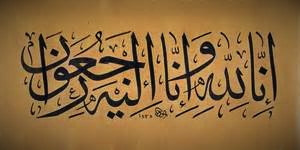
Inna lillaahi wa inna ilayhi Raaji’oon. To Allah we belong and to Him is our return.
Melissa is a Dallas, Tx native who converted to Islam 20 years ago. She is the proud mama to one gorgeous daughter. Melissa still calls Dallas home and in her community she is an active fund-raiser and Girl Scout troop leader, and an awesome sister to all she comes across.
Like the post, share it, pin it, comment on it, and/or do whatever social media magic it is that you prefer. Find out more about us in the understandably named “About Us” page and browse other posts in “Table of Contents”.
There is a saying that many repeat, but some do not apply in their lives, communities, or countries. Educate a women, educate a nation. This saying became very dear to me. It became my mantra. It became the soothing balm when I turned to religious knowledge to fight this denial of education to women.
Educate a women, educate a nation because the child’s first teacher is her mother, because the husband seeks advice from his wife, because a woman who helps herself out of poverty with her education helps her whole family out of poverty. But more than all that, educate a women because education is her basic human right.
The fact that this needs to be said and is not just something everyone knows is truly depressing.
Muslims have a history filled with female scholarship, secular and religions. The Prophet Muhammad (PBUH) set aside days on which to teach the religion to female companions. And he did not just set these days aside to separate women as some will have you think. Men and women sat in sermons together. He set aside a day for women to pay special attention to the women of his community, to give their questions, concerns, and education the attention it deserved.
Abu Sa‘id al-Khudri reports that some women said to the Prophet (PBUH) “men have gone ahead of us (in terms of acquisition of knowledge). Therefore, appoint a special day for our benefit as well.’ The Holy Prophet (PBUH) fixed one day for them. The Prophet (PBUH) would meet them on that day, advise them and educate them about commandments of Allah Almighty”. (saheeh al-Bukhari)
Aishah and Umm Salamah (ra) are among the greatest narrators of hadith. Much of what Muslims practice today in terms of their religion is transmitted via the education of these two great women. The world’s first institution of higher education, the University of Qarawiyyin in Morocco, was established by a Muslim woman, Fatima al-Fihriyya.
Ash-Shifa bint Abdullah was skilled in medicine and appointed by Umar (May Allah be pleased with them both) to a position of public administration during his caliphate. Rabi’ah bint Mu’awwad was a great scholar of Islamic law who taught even the male scholars of Madinah.
Not only did the Prophet (pbuh) facilitate the education of his female companions and set forth an example for future generations. He emphasized the utmost importance of education when he said, “seeking knowledge is mandatory for every Muslim.”
We also find Allah repeatedly telling us in the Quran to ponder, think, analyze, making no distinction between men and women.
Seeking of knowledge or education for a Muslim is not distinguished between sacred and secular or even male or female. And the implication of these sayings of the Prophet and directives of the Quran is that every Muslim should pursue his or her education as far as it is possible, remembering that Allah tells us in the Qur’an: “Only those of His Servants who are learned truly, fear Allah” (Al-Qurân, 35:28).
Despite all this, in modern history, some parts of the Muslim world have seen a decline in female scholarship, due to the erosion of women’s rights – God given rights. And as a result, the Islamic world has seen a perpetuation of uneducated and poverty stricken communities and further deterioration of women’s rights.
In many parts of the Muslim world women are being highly educated and that needs to be celebrated. But still the fact remains that this is not true for all women and especially in parts of the world were “Muslim” radicals roam wild. And even if one girl is denied education based on her gender or because of some made up religious ruling, it is a topic the MUST be addressed and thoroughly refuted.
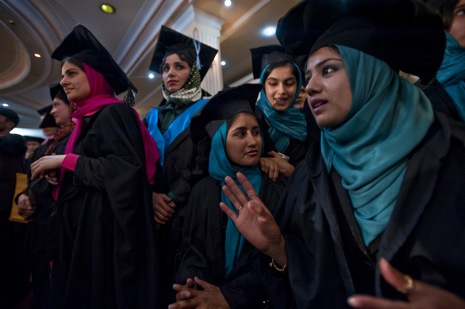
It is of the utmost importance for girls to regain their place at the grammar school desk, for women to take up their spots in the university, and in the tradition of scholarship, to reclaim the tradition of highly educated and empowered Muslim women.
According to a paper by Islamic Relief, a charitable organization which supports education programs throughout the Muslim world, “… girls’ education in particular has been shown to have substantial economic and social benefits … Studies have shown that communities with a high proportion of educated mothers have less health problems.”
Islamic Relief tells a story of one woman named Uzra who not only improved her own life through education, she also benefited the lives of everyone around her.
When Uzra was illiterate, she couldn’t help her children with their studies or read instructions on medication. Now, thanks to our women’s education programme, she can read and write, and runs a business employing 48 women. This income is vital as Uzra’s husband is disabled and cannot work.”
A number of studies show that a girl who is educated is better able to bring up her children in safety. She is better prepared to educate them. She is more likely to keep her family healthy. She will also be able to work and earn a living, crucial in many places where one wage is just not enough. She will likely live a life with less struggles and more fulfilment.
It is of the utmost importance to educate women, to educate our nation, to pull ourselves out of poverty, to have spiritual fulfilment, to have a chance.
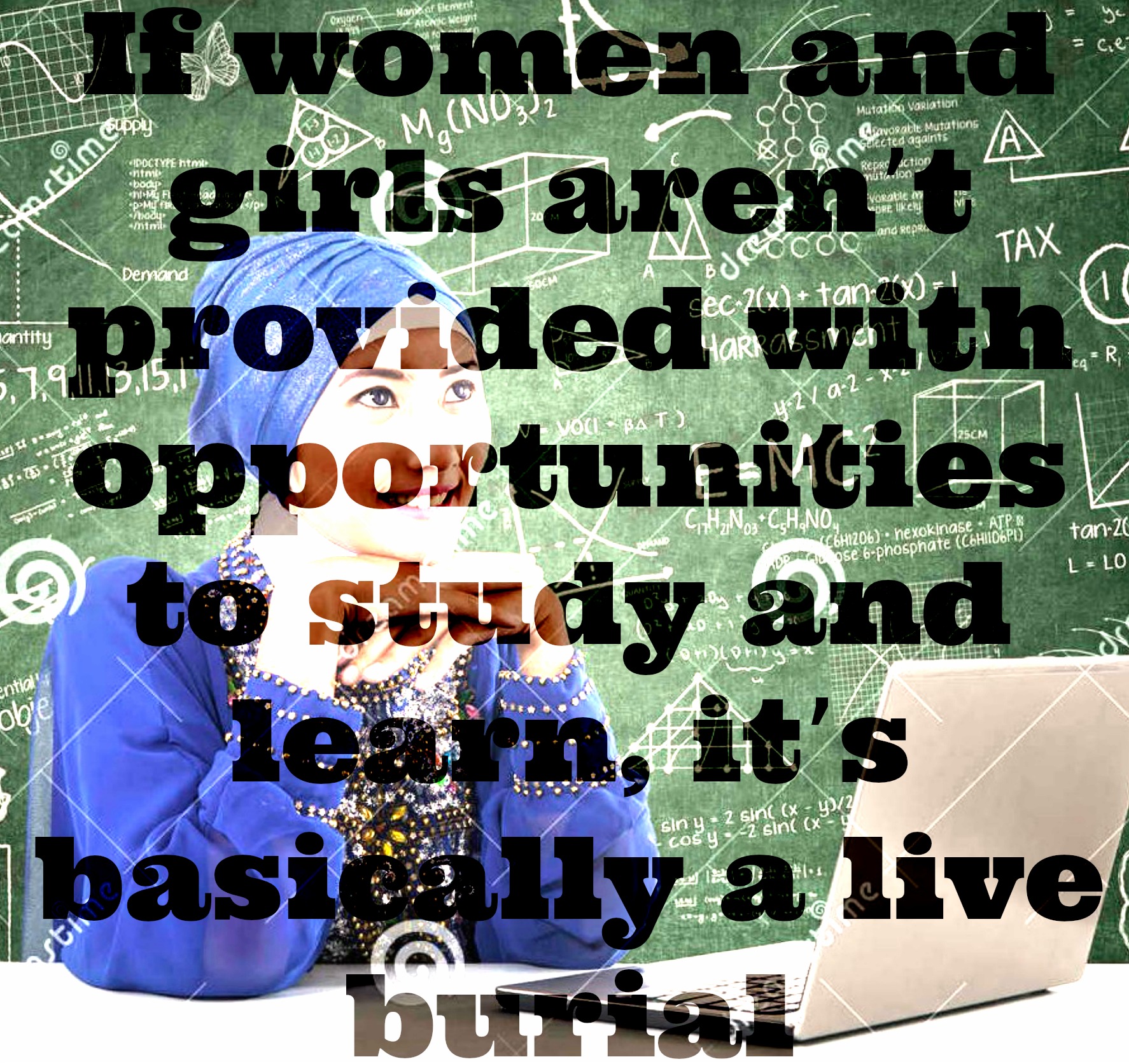
picture from Dreamstime
Shaykh Mohammad Akram Nadwi says, barring Muslim women from education and religious authority is akin to the pre-Islamic custom of burying girls alive. I tell people, ‘God has given girls qualities and potential.’ If they aren’t allowed to develop them, if they aren’t provided with opportunities to study and learn, it’s basically a live burial.
Like the post, share it, pin it, comment on it, and/or do whatever social media magic it is that you prefer. Find out more about us in the understandably named “About” page and browse other posts in “Table of Contents”.
What follows is a speech given by Myriam Francois-Cerrah on the problems with feminism as it is viewed from the lense of white middle-class women. Being a white, middle-class woman, a feminist, and a Muslim it feels strange to reblog this. But as Francois-Cerrah says, “If it takes my white privilege to amplify this message, at least it will have served one positive purpose in the broader struggle for human equality”.
Last week we met Ali and Jennifer, a newly-married Muslim couple hailing from opposite sides of the globe.
Ali and Jennifer were caught in an issue that often arises in new marriages of the Islamic persuasion: the double-standard. Specifically, that men are often held to (or hold themselves to) different customs, traditions, rules and expectations than women are – within their families, within their societies and within marriages.
As previously discussed, the first way the ridiculous double-standard appear in an Islamic marriage is through the unequal expression of anger. For more about this, please check out Part I here.
The second way double-standards pop up in marriage is through the concept of working – both inside and outside the home.
Working Inside the Home
It’s no secret the United States experienced its own Women’s Suffrage movement during the late 1800s to early 1900s. That was merely to obtain the right for women to vote in federal elections. However, total equality for women is still a far cry from being checked off on the To-Do List of American Civil Rights.
lordin’ it over the Wife
Despite women holding some of the highest positions of power in the States, and other “Western” countries – okay, that ONE position still hasn’t been attained yet … 2016, insha’Allah! – there are still certain stereotypes assigned to women and men, respectively, based on tradition and culture.
Move over a couple of continents, to where men are predominantly raised as princes, catered to for every menial task, and a new wife has a whole load of extra responsibility piled onto her that she might not have been asking for.
Add to this reinforcement by in-laws, society and misguided “scholars”, and the poor girl thinks she has no other choice in the matter but to be her husband’s servant for all of married life.
Take for instance Jennifer. When she moved in with Ali after they got married, she expected he would do his part in taking care of the home. After all, her father had always done his part around the house, especially when her mother worked long hours. When she and Ali had discussed marriage roles, she had mentioned that she was used to her father being active around the house. Ali had not disagreed at the time.
At first, Ali did make sure to keep his dirty clothes in the laundry room. He would also bring his dishes to the kitchen after eating, and he would take out the garbage if Jennifer asked him to.
One evening while they had guests over for dinner, Jennifer called Ali in from the living room to help her make coffee.
“Why did you call me like that in front of our guests?” Ali asked, coming into the kitchen in an angry rush.
“I want you to help me carry the coffee and dessert.” Jennifer held out the coffee pot and some plates.
“I can’t do that.” Ali turned and left the kitchen.
Confused and upset, Jennifer called him back into the kitchen, but he didn’t respond. In order to save face, she took the coffee and dessert out into the living room, served the guests and participated in the conversation until the other couple decided to leave.
As soon as the door closed behind them, Ali spun around in anger. “Don’t ever ask me to serve guests in my home!”
“What is wrong with you?” Jennifer asked. “They’re both of our guests. I’m not a servant.”
“No, you’re my wife. It’s not a man’s job to serve other people. It’s not my responsibility to bring coffee and dessert.”
“Oh, really?” Jennifer put her hands on her hips and cocked her head to one side. “So, I suppose it’s my job?”
“Absolutely!” Ali stormed down the hallway, coming back a few moments later. “Where are my black pants?”
“Which black pants?” Jennifer was busy washing dishes, and she wasn’t in the mood to argue any further.
“The ones I wear to the gym. I put them in the laundry basket two days ago.”
“Are they not there?”
“I didn’t look. Didn’t you wash them?”
Jennifer let the dish drop into the sink and turned around. “No, Ali. I have been busy. I have a job, too, you know. I only do laundry on the weekend. If you needed them washed, you should have washed them. I didn’t put a password on the washing machine.”
“Wash my own clothes? What do I look like . . . a woman?”
With her mouth hanging open, Jennifer stared as Ali returned back down the hallway to their bedroom and slammed the door.
And so enters the familiar concept of housework being women’s work and men being free to make their messes and leave behind their piles of dirtiness and stinkiness without a second thought of who should be cleaning up after whom. You know, ‘cause it is beneath a man to clean a toilet. Buddy, you didn’t have any problems making it dirty. What makes me the default go-to for your sanitation process?
But this culturally-based idea of men’s immunity to housework is so ingrained in the minds of both women and men from many countries that it often goes unquestioned until it presents a problem in a mixed-culture marriage like Jennifer and Ali’s.
Of course, if we ask Ali, he’ll say that it’s the way it’s always been, or women are supposed to work inside the home and men are to work outside the home. He may even cite some reference about how the Qur’an says women should “stay in their homes”.
However, what he will most likely avoid referring to is the issue itself: why must women be the ones to pick up after grown men that possess the ability to do it for themselves?
Why are men allowed to sit like kings in their homes, being served by women in every capacity from massaging their feet, bringing them food and drink to practically cleaning and dressing them?
Well, the answer is simple. They’re not.
When asked about how Prophet Muhammad (pbuh) acted in his home, A’isha (ra)said:
He was a human being like any other; he would clean his garment, milk his sheep and serve himself.
Additionally, Sadaf Farooqi tells us the Prophet (pbuh) did the housework and did not “lounge around” expecting the womenfolk to wait on him “like a king on his throne” – even though he did work outside most of the time (and the hadith about the Prophet doing housework is often misquoted as he “helped” with housework. This implies it was the wife’s duty, and he helped anyway. This is not the case. The hadith does not mention helping, but simply doing things for himself. . .because. . .well, he wasn’t broken or incompetent.)
After discussing the double standard of completing housework, it is only natural to move into the final and complementary issue of working outside the home.
Working Outside the Home
It is uncommon nowadays to find a marriage where both partners aren’t working. Even in the youngest countries in terms of “modernism”, newlyweds in their mid-20s to early-30s expect that both the wife and husband will need to work outside the home.
it’s a balancing act
Yet, the expectation remains that the wife, when her “job” is said and done for the day, will come home and keep working until she goes to bed at night: doing the dishes, bathing the kids, cleaning the house, cooking the food.
What ends up happening is the wife becomes overly stressed while the husband sits back and enjoys his time of relaxation after the work day is finished.
Some people say this is the woman’s problem, as she shouldn’t be leaving the house to work, anyway. But there’s nothing in Islam that forbids women from working outside the home.
As we know, Khadijah (ra) was a successful businesswoman even before the Prophet (pbuh) married her. In fact, El-Sayed Amin explains, it was through her business that she met her future husband.
Furthermore, it was Hind bint Utbah and Asma bint Abi Bakr who were instrumental in the success of the Muslims at the Battle of Yarmouk. Clearly, if women were permitted to fight alongside men on the battlefield, then their leaving the house to work at supermarkets in order to help support their families or schools to cultivate knowledge is not an issue.
But what is an issue is the insinuation that women should work outside the home and be responsible for all the work inside the home when they return. Not only is this not fair, but it is totally un-Islamic, as we see above in the discussion of the Prophet (pbuh) and his actions inside and around his home.
And just like in Twilight, this dude is not a real man.
Even worse, many men do not work outside the home. Instead, they rely on their wives to support them . . . and still expect them to take care of the children and the home upon their return from work!
The husbands will sit on the couch watching TV or sleep most of the day, and they don’t lift a finger to help their exhausted and over-stressed wives. Why? Because it’s not their job.
Now, I shouldn’t have to provide a reference showing how ignorant and selfish this belief is. Furthermore, what it ends up leading to is resentment on the part of the wife, and ultimately, dissolution of the marriage and family.
Conclusion
In short, there is only one way to fix the issue of the Double Standard Dilemma in Islamic marriages: communication. It’s one thing to clean up after your husband and serve him if it’s something you want to do. It’s another thing totally to force it on your wife because you believe it’s her job.
And among His signs is this, that He created for you mates from among yourselves, that you may dwell in peace and tranquility with them, and He has put love and mercy between your (hearts): Verily in that are signs for those who reflect (Quran 30:21).
Follow us (upper right of the page), email us (islamwich@yahoo.com), like our face with your face on Facebook, like the post, share it, pin it, comment on it, and/or do whatever social media magic it is that you prefer. Find out more about us in the understandably named “About Us” page and browse other posts in our “Table of Contents”.
Jennifer* was a convert Muslimah. Though she had only recently reverted to Islam, she was always a modest young woman, trusted wholly by family and friends.
About a year after her reversion, she met Ali*. He was a few years older than Jennifer, but since she had always been an “old soul” she was okay with the age gap. After meeting with him a few times, under halal (permitted) conditions, they agreed to marry. She had asked him every question that came to mind about their respective roles as husband and wife, but because of her conservative pre-marriage lifestyle, Jennifer assumed the basic routine of day-to-day living would remain generally the same for her.
One evening Jennifer made plans with a friend for dinner. Prior to going out, she let Ali know her plans, as he was also going out with friends for the evening. As she wrapped her hijab, Ali popped his head into the bedroom.
Jennifer looked at his reflection in the mirror and smiled. “I’m excited to see my friend. I haven’t seen her since college. We used to sit together for hours, just laughing and talking.”
“I’m leaving now. What time are you meeting her?” Ali leaned against the frame, crossing his arms over his chest.
“About seven. Great! So we’ll probably get back home around the same time, I’m guessing.” She stuck a final pin into the side of her scarf, grabbed her bag off the dresser and turned to leave.
“No. I’ll probably be late. Maybe around eleven or later.”
Jennifer walked over to him and patted him on the cheek. “Me, too. I told you. . .we can sit for hours.”
Ali shook his head and laughed. “Are you serious? No way.”
She stepped back, confused. “No way what?”
“No way about you staying out until eleven. That’s no good. Women shouldn’t be out that late.”
Jennifer laughed to herself. “What do you mean? I’m not going out to a club. I’m eating dinner, sitting with my friend in a restaurant. Besides. . .you said you’d be home around eleven or later. What’s the difference?”
“The difference is I’m a man.”
ONE NIGHT ONLY: Woman vs. Man!
And so it starts. The beginning of a recurring theme running through many, many marriages.
The double standard.
Of course, we can’t just limit this to Muslims, or even Arabic culture (a major contributing factor to this issue to begin with). However, for the purpose of this blog, I am only looking at the concept of double standard within Islamic-based marriages. To focus discussion even further, I will limit my scope of criticism to three areas of double standardization:
Expressing Anger
Working Inside the Home
Working Outside the Home
Expressing Anger
Somebody got some ‘splainin’ to do!
For those of you familiar with the I Love LucyShow, the image above most likely conjures memories of hilarious scenes between the title character, Lucy, and her Cuban-imported husband Ricky, wherein Ricky spends a great amount of time chiding his naïve and childishly-scheming wife in a mixture of Spanish and heavily-accented English while wagging his finger in a patronizing manner.
This is met, in return, by a loud, whining, “Waaaaaaaaahhhhhhh,” by Lucy, who offers the iconic phrase with closed eyes and a wide-open mouth. Add in the later Technicolor effects of Lucy’s bright red hair and unmistakable lipstick and you’ve got one funny picture.
Of course, if you take a step back and look at the bare-bones story, you see an overly-patriarchal husband chastising his younger wife for something that may-or-may-not be completely her fault. (Well, to be honest, in Lucy’s case, it usually was her fault.)
But the point is, in watching the exchange between the animated couple you hardly ever see Lucy stand up to Ricky. She takes everything he dishes out with a (mostly) closed mouth. And even when she tries to get the upper hand, she does so in a silent, action-oriented manner. . .that often backfires (poor Lucy!).
For those of you who aren’t familiar with the show, you may be wondering why I’ve brought it up.
Because this model is played out in many modern Muslim marriages, in the spirit of “heading the household”, the stronger, usually male, personality takes over and expects all to follow his way.
Western female converts know this posturing all to well. Her more-likely-than-not foreign born husband or even her community believes that the her conversion has been a way for her to escape a “hellbound” culture of capitalism, consumption and hedonism. Clearly, when we become Muslim, there is no desire to maintain any ties to our own cultural identity. . .or we wouldn’t have converted, right? *Sarcasm*
For most, the first sign of the “elite male status” rears its ugly head during the first argument. Let’s assume, for the sake of argument, both husband and wife are converts (this gets rid of the sticky “in my culture” issues that always come up in an intercultural relationship).
Since we understand couples argue for a variety of reasons ranging from stupid to life-altering, let’s say the water bill didn’t get paid, and now the water has been disconnected. This wasn’t due to lack of funds. It was simply due to oversight by one or the other.
What follows is a typical experience for many female converts in terms of arguing with a spouse:
Husband: There’s no water. What’s wrong with the water?
Wife: I don’t know. Maybe the whole building has a problem?
Husband: I’ll ask the neighbor. (Leaves to ask neighbor. Returns.) They have water. It’s just us.
Wife: Maybe the pipe’s broken?
Husband: Did you pay the bill?
Wife: Was I supposed to pay the bill? Don’t you usually take care of that?
Husband: Did you remind me? Let me go see if the pipe is fused. (Leaves. Returns.) They fused the pipe.
Wife: I guess the bill didn’t get paid.
Husband: Why didn’t you remind me? I have a lot of things to do.
Wife: I also have a lot of things to do. I suppose I didn’t think about it.
Husband: That’s the problem. You don’t think about things that are important.
Wife: Of course I do. I’m just not used to thinking about things that I don’t usually take care of. Since you always pay the bill, I didn’t think about it.
Husband: A good wife reminds her husband about important things.
Wife: So, now it’s my fault because you didn’t remember?
Husband (raising voice): It’s your fault because you didn’t remind me!
Wife (raising voice in response): I’m not your secretary! Can’t you make a note of important things?
Husband (yelling): Don’t raise your voice to me! I’m your husband, and you must show me respect!
This is not okay
Wife (yelling back): Well, I’m your wife! Don’t yell at me!
Husband (increasing in volume): I am your husband, and I have the right to yell! But you will not speak to me this way! Do you understand?
Now, depending on the general temperament of the man and woman, this episode will escalate further with both getting out of control, or one person will eventually back down. But the question is: why does the husband believe it to be okay for him to raise his voice at his wife, but not for his wife to raise her voice in response?
Why are women – especially Muslim women – expected to be demure and soft-spoken, even when being yelled and cursed at by the person whom they are supposed to respect and trust most in the world?
Why are men allowed to give in to their human characteristics of anger and displeasure, while women are labelled “emotional” and told to contain their feelings?
It is only natural to want to respond in kind to someone when they verbally attack you, be it through volume or vocabulary choices. However, this is considered taboo, inappropriate or disrespectful of men when women get upset and show their feelings.
What ends up happening is that over time, the woman will start to exhibit traits of an emotional or psychological abuse victim. She will withdraw at the sign of argument, afraid to stand her ground, even when she is right to do so. Her opinions will become invalid, even to herself.
She will contain all feelings, positive and negative, until pent-up aggression and expression will cause her to be overcome with anxiety. And then she will not know where the anxiety stems from, as she’ll end up letting her emotions fly at the most mundane of incidents (see: opening a blister package for medication).
So, what’s the solution? Should women be able to yell back? Are women allowed to yell back? Are they allowed to get angry? To show their emotions like men do? Is it really the man’s right to dominate the situation and demand sovereignty in decision-making?
Once, Aisha was angry at the Prophet – peace be upon him – so, he told her: do you accept Abu Obaida Bin Al-Jarrah as a judge between us? She replied: no, this man will not issue a judgment against you in my favor. He said: do you accept Omar as a judge? She replied: I fear Omar. He said: do you accept Abu Baker (her father)? She replied: yes I accept him.
This exchange shows that no matter how he viewed his own opinion in the matter, even Prophet Muhammad (saw) acknowledged his wife’s right over him to be fairly heard and express her feelings.
He didn’t yell and say, “I don’t care what others think. It’s my opinion that counts.”
Nor did he demand they go to the first person he suggested as a mediator. In fact, he didn’t stop offering names until he found one she agreed with. So, even in their disagreement, he wanted to make sure he found someone who would support her and be fair in their decision about the disagreement.
Additionally, Pakistani freelancer Sadaf Farooqi explains in his article discussing an incident where A’ishah (ra) was verbally attacked by her co-wife, Zainab (ra), in her own home :
He [Muhammad (saw)] did not – and this is a very important key point – exhort the wronged person to keep silent in the name of patience and restraint. He did not allow their oppressor to continue with their injustices. Rather, he made sure that the wrongdoing was not just stopped, but that the one who was wronged also defended themselves.
Even though Zainab (ra) was older than A’ishah (ra), the Prophet (saw) gave his approval for her to speak up about what was being said against her.
Truthfully, the answer is not in who is allowed to yell and who is not.
The answer lies in open communication. Understanding the right that both parties in a marriage have for expressing their opinions, being heard and trusting their partner with protecting (through mutually respecting) their feelings.
One person or the other dominating a relationship and holding the other emotionally hostage is the very definition of dysfunction. As we can see from the example, even our Prophet (saw) permitted his wives to have their say and defend themselves in an argument.
Instead of fighting – yelling, screaming, cursing or worse – couples must learn what works best for each of them when they’re upset or angry. This can take time, but the best answer is being open and honest.
If you need to blow off steam, that’s fine. But make it clear to your spouse this is needed. And then get away from them. It’s okay to unwind and calm down. It’s not okay to do it at the expense of another person’s well-being. And it is evenmore NOT OKAY to say that just because you are male Islam gives you the right to be an emotional bully. . .or worse.
*The couple mentioned in the story at the beginning are fictitious. Any similarity or resemblance to real people is unintentional.
Follow us (upper right of the page), email us (islamwich@yahoo.com), like our face with your face on Facebook, like the post, share it, pin it, comment on it, and/or do whatever social media magic it is that you prefer. Find out more about us in the understandably named “About Us” page and browse other posts in our “Table of Contents”.
Hey, fart faces (I use this term in the most loving way imaginable), I have been working on a very scientific study about marriage dynamics in an Islamic relationship (that mostly involves me thinking of stuff that goes on in my marriage and my cohorts’ marriages). And I have come up with a list of some aggravating and awesome things that come about when you marry a (religious) Muslim man.
Submitted for your approval, j/j submitted for my own amusement:
The Annoying Stuff
1. The Fart Fear
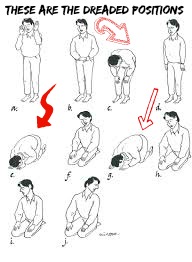
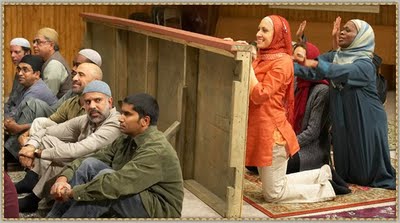
Ever since the first fart of the marriage-you can’t recall who broke the seal, but it happened, and all hell broke loose-you have a very distinct fear. It is irrational, but still haunts the Muslim wife Fajr to Isha (prayer times). It is the fear that his farting on you while on the couch or in the kitchen, or anywhere really, will extend to prayer times, since you stand directly behind him as he bends over and kneels, aiming his biological warfare directly at you.
It is irrational because prayer is probably the only time any Muslim man will do his best to keep it in the chamber. But still it is possible. And for that, many smart Muslim wives fear the fart and move their prayer rugs behind and to the side- out of mushroom cloud range.
2. Thinking Going to the Masjid is a “date”
You know the convo. You say: Honey, we haven’t been out in a while. What do you say we have a date night? Then he responds: We went out just last week. Remember? We went to the masjid for that awesome lecture. I don’t know about you, but I do not consider sitting in separate parts of a building, listening to a religious lecture, a date. But he does. How Romantic!
Hey, Honey! I wanted to tell you how romantic this date is!
3. Finding Beard Hairs in Random Places
It is pretty gross to wake up and pour a delectable bowl of Fruit Loops only to find your man has been there. He has left one gross strand of face hair in your cereal bowl. The best part of waking up is NOT a beard hair in your cup (sung to the tune of the Folgers Coffee jingle).
Get your beard away from my cereal bowl!
4. Wudu Water EVERYWHERE!
Wudu or ablution is a big part of the Muslim man’s (and woman’s) life especially if he farts like I am pretty sure he does. He must be in a state of ritual purity to perform his 5 daily prayers (if one farts or goes potty, one has broken the state of purity and must make wudu). The problem is, come wudu time, he acts like he has been challenged by an ice bucket. And the bathroom counter, floor, and mirror bear the brunt of the water torture.
Wudu is NOT the ice bucket challenge.
5. Perpetual Love Goggles
This is similar to beer goggles that leads a man to believe a woman is more beautiful than she is when the eye of the beholder has had “one too many”. In the case of the Muslim man, the phenomenon happens when a man follows the dictates of the Quran about not ogling women. Your Muslim man does not check out women or compare them to you.
This can result in him never noticing when you gain weight, break out, or generally look like a hot mess. He thinks that
it’s a very professional look.
you are the most beautiful women at the end of the day when all he has looked at are (usually old and fat) dudes. The problem with this is that you really have no idea how you look and your sense of self worth becomes inflated. Not to mention how gross and mushy it is.
The Awesome Stuff
1. Perpetual Love Goggles
Your Muslim man does not check out women or compare them to you.
He thinks that you are the most beautiful women at the end of the day when all he has looked at are dudes. The inevitable result is that you really have no idea how you look and your sense of self worth becomes inflated!
2. He Smells Good
If women are the fairer sex, then men are the smellier sex. Don’t deny it. It’s science. But the great thing about a Muslim man is that he must wash his hands, arms, ears, feet, face and freshen his hair in order to pray. That wudu that left the bathroom looking like New Orleans after Katrina, has also left the Muslim man fresh and less smelly than the average bear. The Muslim man is also encouraged- as a religious tradition -to wear cologne, leaving your Muslim man smelling so fresh and so clean.
This can be dangerous if your man doesn’t follow the sunnah.
3.He Puts Up with Your Hair in Everything
When you wear hijab, something interesting happens. All of your shedding has to happen at home (the hijab keeps it contained and builds up the shedding potential). Once the hijab is removed and the bun is unfurled, the games begin. Your hair, that would have fallen out where ever you go, ends up all over your home: in shoes, on pillows, clinging to clothing fresh out of the dryer, in the cat’s mouth …
But he doesn’t complain about it like you do about his beard hairs in your cereal bowl. He understands.
Let the hairy games begin!
4. Having a Ride or Die Homie
Having a Muslim husband means that you have someone who you know has got your back, someone who will conspire evil midnight doughnut runs with you during Ramadan (or any time really), someone who will warn you of hidden pork at your favorite restaurant, someone who will call up the brothers to come down and take care of anyone who disrespects you, even if they do roll up on their tricycles.
5. Having a prayer buddy
It is nice to hang with someone who knows you schedule your life around prayer and not prayer around your life. This is especially useful in the winter months when days are short and prayers come in almost every other hour and you want to plan a matinee movie around prayer times. Or when you are travelling and one of you takes look out while the other pops out a few rakat.
Much respect to all the Muslim husbands out there who strive to be the best to their wives.
Follow us (upper right of the page), email us (islamwich@yahoo.com), like our face with your face on Facebook, like the post, share it, pin it, and/or do whatever social media magic it is that you prefer. Find out more about us in the understandably named “About Us” page and browse other posts in the “Table of Contents”.
Written by Theresa Corbin, co-authored by Saadia Haq
A Voice from the West
Recently I have gotten a lot of heat for identifying as feminist and a Muslim. I did it very publicly so I am not surprised at the response. I am however, surprised that purported feminists had such a problem with my identity they have gone so low as to call me- a fellow woman they have never met or spoken to- a stupid cow (because having and exercising my basic human right to choose my religion makes me a farm animal), a moron, an attention seeking … fill in the blank …
Aaaand these “feminists” have even perpetuated a harmful female stereotype, by saying that my identity is the result of daddy issues, as if everything a woman does must have something to do with a male relationship- there is no emoji that exists that can express how massively I would like to roll my eyes at this.
But the lack of support-and virulent abuse-I received from my fellow “feminist” was so hideous that it made me wonder what exactly they think feminism is. I know for sure they had no idea what being a Muslim meant outside of what they hear about Muslims and Islam on the news, stereotypes, or from Islamophobic talking heads and reductionists (terrible sources, y’all!).
Then I realized that these ladies (and some men) were only upset because I challenged their misconceptions about what it means to be a Muslim woman, what is means to be a feminist, and by doing so I challenged their very identity (we often define ourselves by negation and not being validated pisses insecure people off). I realized this because I understand the rhetoric in American society and Western culture at large that Islam = bad for women.
The reason I realized this was because I too had many of the same misconceptions about Islam that these people have. That was before I knew what Islam is. You see, it is hard not to carry around these misconceptions when on a daily basis you are receiving messages from everywhere that hijab is a tool of oppression, that Muslim men are somehow more violent and domineering than their Western counterparts and that Islam is just more oppression of women under the guise of religion.
While there are problems that women face in terms of dress, male dominance and religion being used as a tool for oppression (that Muslim feminists are addressing), it is a fallacy to think that these things are only Eastern or Muslim problems as we see them play out daily among non-Muslims in the West. But the stereotypes persists and are amplified of late.
The roots of these stereotypes come from Orientalists’ intentionally mutilated understanding of Islam. And its feminist roots were planted by women like Carrie Chapman Catt and Aletta Henriëtte Jacobs, who travelled the world to unite women in the cause of equality and they should be celebrated for their efforts. But these ladies and many women like them couldn’t get over their own superficiality and arrogance. When they saw Muslim women dressing modestly in hijab, they took it as proof that men were using all they could including clothing to control women.
These feminists clung to their Orientalist understanding of Islam (some say it was only propagated to create reasons to colonize Muslim countries. i.e. Christianity good/Islam bad therefore, the more “advanced” Western Christians must “rescue” people from their “backwardness”) and they never once thought to ask the Muslim women why they cover their bodies the way that they do. Or even if it was something that Muslim women wished to do of their own accord. No, they just assumed it was because Muslim women were too weak or feeble-minded to even see how they were being oppressed. (See Unveiling Scheherazade)
These early feminists completely ignored the fact that these Muslim women used the public space and political forum to fight for their causes. These efforts were ignored because Muslim women weren’t fighting for the causes Western women thought they should be fighting for (removal of the veil). So they took it upon themselves to free these “poor” women from the things they didn’t need saving from and ignored the real struggles they faced. This was par for the course in Western colonial dealings with indigenous peoples.
and some are still at it.
I have felt this attitude and its far reaching effects through time and place in my own life. When I compare how I was treated as an identifiably white women to how I am treated now that I wear hijab, the difference is striking. I was, previous to my Islamic identity, treated like a competent, actualized, thinking human being. I was listened to and even sought out for my opinion. The story is totally opposite now that I am recognizably Muslim. Now I am often treated like a child, talked down to and even flat out ignored. So much so that I often wonder if I am invisible or on mute. I suffer from the legacy these first feminist left to future generations as to how to treat the “other”.
Sure, I know what you are thinking, feminists have moved past this type of thinking and acting. And I would have to agree with you that many modern, Western feminists have gotten past this. Some of my best friends are third-wave feminists. These ladies understand that each women’s struggle is her own and should be heard and dealt with in the way she wishes for her life.
And third-wave feminism arose partly-or largely, depending on whom you speak with- because of the failure of former feminists to understand that women are diversified and that women of all ethnicities, nationalities, religions and cultural backgrounds are also entitled to equality and agency in the ways they see fit for their lives.
So why are so many feminist still stuck in first and second wave feminist thinking? It all goes back to what the media is selling and what the masses are buying. Stereotypes that is (definition- where a few cases are taken as representative of the whole. Thought it would be better to clear that up now instead of in the comments.)! They are sold fresh and hot off the presses daily. And this creates a weirdness where feminism is growing and supporting women in their choices, but many still cling to colonial mindsets that says to be actualized you must first be Western, White, and Christian (today that translates to: If not Western then at least westernized. If not white then at least whitewashed. And if not Christian then at least not Muslim). And if you “fall short” in any of those categories, you will be dismissed. It will be assumed that you are not capable.
In the Western culture, we have done little to address this arrogance in our thinking and we see it acted out by groups like FEMEN who wish to “save” and instruct the Muslim woman on what feminism really is. It is this idea that somehow someone else (here: FEMEN-style feminists) has a better understanding of what is best for you (here: Muslim women) than you do, that has a distinct smack of patriarchy by way of feminism.
Muslims women are not now and have never been interested in being told what our struggle is. We are not interested in being spoken for. We are not interested in being rescued.
Because the thing is that Muslim feminists have been doing a lot in terms of bettering our sisters’ lives, the lives of oppressed minorities and humanity at large, from within the framework of our faith. The thing is Muslim feminists have a lot more work to do in terms of being heard, gaining rights and ridding our lives of barbaric cultural practices. We just choose to do so in a way that WE see best.
Our struggle is real. And we understand it better than anyone else. We don’t need anyone adding to our struggle by judging us incapable based on the religion we choose, the hijab we wear or don’t wear, or the color of our skin. We don’t need to be reduced to nothing more than our scarves or dress code (a form of objectification and a huge obstacle within feminism). It makes our efforts ten times harder. How can we engage at all if you treat us as lesser beings? Respect is critical and for all.
So if you are interested in supporting us in our struggle ask us how (see part I). If you are a non-Muslim who wishes to “enlighten” us as to what our religion is, we are not interested in your superficial reading of Islam or your condescension. If you are interested in telling Muslim women we cannot be feminists, understand that you have no right. If you are interested in telling Muslim women how to be feminist, know that you missed the point of feminism.






















 islamwich