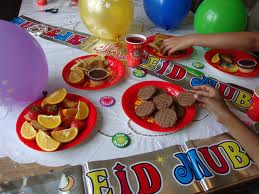
Image

Humor in Muslim Heritage?

humor in Muslim Heritage title

Written by Theresa Corbin

Originally published on OnIslam.net-

Did you hear the one about the Priest, the Rabbi, and the Imam who walked in to a bar?

Of course not! Imams don’t drink.

Bad jokes aside, most of the non-Muslim world imagines that Muslims live humorless and austere lives, never even cracking a smile.

Talk of Muslim scholars hearkens images of severe men in ivory towers handing down fatwas to a world they know nothing about – and admittedly and unfortunately sometimes this is true, but it is very far from the majority.

I hear it all the time. Every time I crack wise or show the lighter side of my personality, non-Muslims who happen to be in ear shot are always shocked and make it known that they didn’t expect me to be … gasp … funny!?

Confusion ensues, and I am written off as an anomaly. But this is so far from the truth it is not even … um, well … funny.

The Muslims have a long and hilarious history replete with a smiling and joking Prophet (peace be upon him), prankster companions, Caliphs who knew how to laugh at themselves, jokesters throughout the ages and even a long lost joke book written by revered scholar.
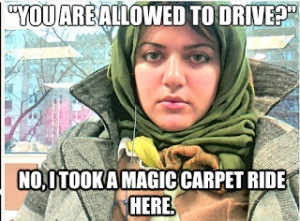
funny hijabi
We got jokes too!


A Smiling Prophet

Think of a Prophet, any Prophet. What comes to mind?

For most people, recalling a Prophet is to think of a man suffering in rags, living a sad and hard life.

To the Muslim, a Prophet is someone who is serious when the occasion calls for it, but is good natured and often found smiling. The Prophet Muhammad is often called the smiling prophet and many anecdotes of his joyful and smiling disposition are quoted in hadith.

One such hadith, Abdullah ibn Haarith said:

“I never came across a person who smiled as much as Prophet Muhammad. Prophet Muhammad regarded smiling to a brother as an act of charity.” (At-Tirmidhi, 3641)
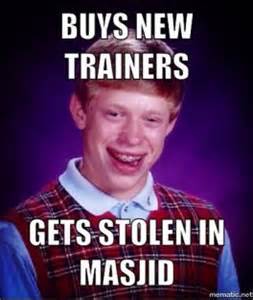
"trainers" is the brits' funny way of saying sneakers.
“trainers” is the brits’ funny way of saying sneakers.

He Could Make a Joke

Several instances can be found in the sunnah where the Prophet (peace be upon him) is cracking jokes with his companions and family.

“Once, an old woman came up to him [the Prophet] and asked for paradise. He said:

“Old women do not enter the paradise.”

The woman started crying. As she started leaving the room, the Prophet, showing his subtle sense of humor, stopped her and said:

“Old women will become young before entering the heaven.” (Shama’il Muhammadiya, 230)

He Could Take a Joke

Not only could he dish it out, but he could also take it.

Once a companion of the Prophet named Nuayman (who was a known prankster-may Allah be pleased with him) went to the market and saw some food being sold which appeared to be delicious.

He had some of it sent to the Prophet Muhammad as if it were a gift. The Prophet was happy to receive the lovely gift of food and he and his family ate it. The seller of the food then came to Nuayman to collect the money and Nuayman said to him:

“Go to the Messenger of God it was for him. He and his family ate it.” The seller went to the Prophet asking for the price of the food. The Prophet in turn asked Nuayman:

“Didn’t you give it to me?”

“Yes,” said Nuayman.

“I thought you would like it and I wanted you to eat some of it so I had it presented to you. But I don’t have any dirhams [an increment of money] to pay the seller. So, pay, O Messenger of God!”

The Prophet had a good laugh and so did his companions. The laugh was at his expense, literally, because he had to pay for the unsolicited “gift”.
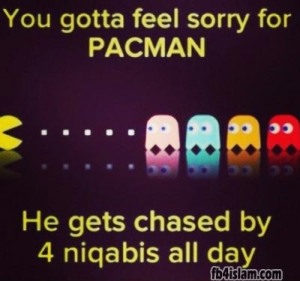
niqab = face veil naqabi = strong and brave woman who wears face veil.
niqab = face veil
naqabi = strong and brave woman who wears face veil.

His Companions Knew How to Laugh Too

The companions followed suit and didn’t take themselves too seriously. During the caliphate of Uthman after the Prophet’s death, a group of companions were sitting in the mosque. They saw Makhramah ibn Nawfal, who was by this time old and senile.

Makhramah got up to relieve himself and because of his blindness might have done so in the mosque. Nuayman (at it again) got up and went to take him to another place.

Little did Makhramah know, Nuayman had not guided him to the proper place but guided him to relieve himself in a place that was still in the mosque!

People shouted at Makhramah. The poor old man was distressed and said:

“Who has done this?” The people told him it was “An-Nuayman ibn Amr”.

The old man swore and announced that he would knock Nuayman on the head with his stick.

Nuayman left and returned. He was scheming again. He saw Uthman, the leader of the Muslims, performing prayer in the mosque. Nuayman also saw Makhramah. He went up to Makhramah, changed his voice, and said:

“Do you want to get at Nuayman?”

The old man shouted:

“Yes, where is he?”

Nuayman took him by the hand and led him to the place where the Caliph, Uthman, stood and said to him:

“Here he is!”

The old man raised his staff and beat Uthman. Blood flowed and the people shouted:

“It’s the Amir al-Muminin [meaning Uthman]!”

In spite of the blows he had suffered, Uthman was still able to laugh at the deeds of Nuayman.

He can do it. He's just goota be able to stand on his own first and know more Quran than everyone esle. Shouldn't be hard.
He can do it. He’s just gotta be able to stand on his own first and know more Quran than everyone else. Shouldn’t be hard.

Humor of Later Generations

This jovial tradition and pranking doesn’t end with the Prophet or his companions.

Tales are told of a hilarious man named Juha who lived in the 8th. century. Juha was a Muslim and a comedic figure who was famous for his hundreds of stories that still remain popular in the Middle East.

One of Juha’s stories is about him being flawed. He is caught lying and jokes about it:

“A neighbor came to Juha and said:

‘Lend me your donkey, for suddenly I find I have to go on a journey.’

Juha, who did not wish to lend the man his donkey, replied:

‘I would willingly lend it to you, but alas, I sold it yesterday’.

Just then, the donkey, which was in the stable, began to bray in a deafening manner. The neighbor jumped.

‘But your donkey is in the stable,’ he remonstrated. Juha replied angrily:

‘You fool, would you take the word of an ass against mine?'” (Source)

In the 11th. century, a revered Baghdad Muslim scholar known as al-Khatib al-Baghdadi penned a wisecracking guide for party crashers.

“The tome was originally authored by […] a well known scholar of the Prophet Muhammad’s teachings. According to Emily Selove of the University of Manchester, who did the translation, he wrote the book to remind readers ‘that every serious minded person needs to take a break.’” (Source)

Today Muslim scholars follow in this tradition and joke in lecture and on Twitter and Facebook. Muslims around the world laugh along and add to the good natured joshing.


If you want to see more comedy from the Muslims check out Baba Ali’s website, check out some of islamwich’s lighter posts, and/or (very highly recommended) plan a trip to Memphis, TN for the Muslims In-Memphis’ Kosher and Halal comedy night on March 21.
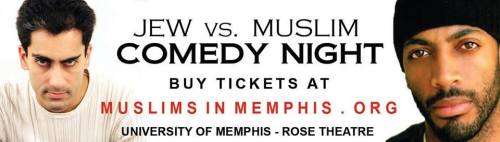
mim comedy night

Stay tuned for next week’s post where I tell you all about my adventures, interviews, and talks in Memphis!

 Do you got jokes? Share them in the comments.

Follow us (upper right of the page), email us (islamwich@yahoo.com), like our face with your face on Facebook, like the post, share it, pin it, comment on it, and/or do whatever social media magic it is that you prefer. Find out more about us in the understandably named “About Us” page and browse other posts in our “Table of Contents”.



Image

Missing Muhammad

missing muhammadI have been walking around the past few days in a serious funk, wondering what was bringing me down. I had been attributing it to the news.


I woke up Wednesday to the news of 3 beautiful, intelligent, young Muslims murdered in their home by an Anti-theist who hypocritically claimed religion is the source of violence and hatred in the world.

On Thursday, I researched a case of a mosque burning in Ohio in 2012 where the criminal who set the blaze claimed he never met a Muslim and did not know what Islam was beyond what he heard on Fox News and talk radio.

Then I came upon a story where a women murdered a fellow human being by pushing him in front of an oncoming subway because, as she said, “I pushed a Muslim off the train tracks because I hate Hindus and Muslims ever since 2001 when they put down the twin towers I’ve been beating them up.” Her conflating of the two vastly different faiths shows her obvious ignorance.

does this look like religious freedom to you?

Just this morning, I  read news of an Islamic community and education center in Houston, TX that has burned down (it is not known yet if this was an accident or a hate crime). And I read about the murder of a 15 year old Muslim in Kansas at the hands of a man who harassed and taunted him for his faith.

I read several posts in my Facebook news feed over the past few days of Muslim women being insulted and harassed.

These crimes against humanity lay at the feet of Muslim Extremists, White supremacists, Christian Extremists, Fox News Talking heads, Talk radio bigots, Islamophobes, Anti-theists, and anyone who spreads hate and cheers in the face of lost lives and violence. It is my hope that these crimes will make them lose sleep and in the process lose their insane ideologies.

It is a distinctly sinking and sickening feeling to know that people hate you, want to see you suffer, want to kill you … people who don’t even know you. It is horrifying knowing that the media and well-organized and well-funded groups are implicit in twisting my religion and spreading lies to create this hatred of me and my people. It is most terrifying knowing that some weak-minded and uneducated Muslims play into this twisting of Islam and perpetuate these lies!

But still, this was not entirely the source of my melancholy.

Media lies and dehumanization of Muslims is nothing new. Islamophobes and their dark hearts have campaigned to distort my faith and defame me, my brothers, and sisters since the 7th century. Muslim ignorance and intolerance has been rife since Muslim majority lands have been torn apart, colonized, and continually destabilized by Western powers. And I have lived knowing these facts for more than 13 years.

However, the funk I was in took a different shape when I watched a lecture on YouTube by Nouman Ali Khan, a bright scholar of Quran and the Arabic language. While watching his lecture, I realized that nothing that will happen to the Muslims will be worse than the death of Prophet Muhammad (PBUH-peace be upon him).

I realized I was mourning the loss of the Prophet Muhammad (PBUH), a man I knew so well, but had never met. Yes, I had been depressed because of the lost lives and fear my community is facing. But also because in this time of crisis we will never again have Muhammad (PBUH) to lead us with the ultimate wisdom and mercy he came with.

It was the guidance from God that I missed. It was the man God sent with a smile and a sense of humor that I missed. I missed urgently and deeply a man I had never met.

And now, as I write this, I realize that we have his legacy. We still have God’s guidance sent through Muhammad (PBUH). And we can pick up were he left off. We can do our best to do as Muhammad did.

(from an article I wrote for OnIslam.net)

We can be honest like him

He was known as Al-Sadiq (the Truthful) and Al-Amin (the Faithful) among all that knew him—even his enemies.

When the Qaiser of Rome received a letter from Muhammad (peace be upon him) inviting the Qaiser to Islam, he asked Abu Sufyan about Muhammad. Abu Sufyan, who at the time was a staunch opponent of Muhammad’s message, said:

“Muhammad is nobly born; is honest and truthful, and has never broken a pledge. He enjoins his followers to worship none but One God and to pray to Him alone. He preaches kindness, piety and, tolerance towards all. And his followers are on the increase.”

This man was so honest that even his enemies called him the honest and the truthful. We can be like this too.

We can be protective like him


Muhammad (peace be upon him) lost his father before he was born and his mother at an early age, an experience that left a lasting impression on him. Having been vulnerable at an early age, he advocated for the good treatment of those who are vulnerable in society. He would attend to the needs of the indigent and the widowed. He took care of the orphans, and recommend others to do the same.

The Prophet said:

“The one who looks after and works for a widow and for a poor person is like a warrior fighting for Allah’s cause.” (Al-Bukhari, 6006)

“The best house among the Muslims is one where an orphan is well treated, and the worst house among the Muslims is one where an orphan is badly treated.” (Ibn Majah, 3679)

We can be good to the widowed, orphaned, the homeless, and the helpless in society. Nothing is stopping us but our selves.

We can seek justice like he did


Muhammad was an advocate for blind justice. He said:

“Assist your Muslim brother, whether he be an oppressor or oppressed.”

And when a companion of the Prophet asked:

“But how shall we do it when he is an oppressor?”

Prophet Muhammad replied:

“Assisting an oppressor by forbidding and withholding him from oppression.” (Al-Bukhari, 2444)

Here is a man who told people to be loyal to justice first even if it means witnessing against your own self. We too can reignite this revolutionary thinking-  and end bigotry, racism, sectarianism and so much more.

We can be honorable like him

Muhammad (PBUH) treated women with dignity and told his followers to do the same.

He never lifted a hand against a woman. He never lost his temper with a woman. He sought advice from women and advocated for women’s rights and their good treatment.

Prophet Muhammad (peace be upon him) told his followers:

Only an honorable man treats women with honor and integrity. Only a mean, deceitful, and dishonest man humiliates and insults them.”

Muhammad (PBUH) left an example to men and women alike. He emphasized the need to respect each other as full and actualized human beings.

We can be patient like him


Muhammad (PBUH) told us “The strong person is not the good wrestler. Rather, the strong person is the one who controls himself when he is angry”. This is an inspiration. We can claim self-control for ourselves as the only true strength.

Through learning about the legacy of his behavior, teachings, compassion, strength, and mercy; I learned how amazing a human being could be.

I learned what it means to love and respect someone I would never meet in this life. And I missed Muhammad. I still miss him, but I seek comfort in knowing that I and my brothers and sisters can and do strive to live his legacy.

Quran 25:63 And the servants of the Most Merciful are those who walk upon the earth easily, and when the ignorant address them [harshly], they say [words of] peace.”

Follow us (upper right of the page), email us (islamwich@yahoo.com), like our face with your face on Facebook, like the post, share it, pin it, comment on it, and/or do whatever social media magic it is that you prefer. Find out more about us in the understandably named “About Us” page and browse other posts in our “Table of Contents”.

Image

Polygamy Explained, Part 2: Rules of Engagement

Written by Theresa Corbin

Part I here

Many people have an emotional response to the thought of polygamy.

It only makes sense. When you ask someone to think logically about their emotional relationships, it can be difficult.  The ugly emotional center of the brain rears up and goes into attack mode, bullying the more logical frontal lobe into submission.

polygamy explained part 2

It is hard to separate the emotional and the logical. Add that fact to the fact that we live in a culture that is emotionally attached to believing Disney fairy tales are true … and happen in real life … makes it very difficult to have a logical conversation about polygamy. 

But we can logically conclude that if a bird has never flown in your window and helped out with your laundry, it is less likely that a good looking, well-mannered, charming, respectful man or woman from a royal line and tons of money and super good looks will swoop in and solve and/or save you from every problem you have.

And you will most likely not live happily ever after just because you have faith in love. To my mind, this leads to alcoholism. Sorry to break the news. We are all just people and we all screw up and break each other’s hearts.

In the previous post our good friend Gracie touched on the topic of polygyny (Polygamous marriages where a man marries more than one women) and gave examples of when it is advantageous for women.

And she pointed out that, while we live in a society and a time where women have many opportunities to be educated and independent, not everyone has this system or these opportunities. And even those who do have these opportunities, may still choose polygamy for other reasons.

For some people polygamy works (but if you are in a country where it is illegal and you want to get polygamous, you have two options 1-don’t do it, or 2-leave). That is not to say it is for everyone. It REALLY isn’t.

A tip for the sisters: No one should make anyone be a part of a polygamous relationship against their will.

Muslims didn’t start the party

Some non-Muslims base their opinion of Islam solely on the practice of polygyny. But can we please, just for today, remember a little further back than the American media recommends? 

Islam was not the initiator or promoter of polygamy. Polygamy was being practiced long before the existence of Islam. Jews, Christians, and many other [religions and] cultures practiced polygamy, and some still continue to do so. Famous prophets practiced polygamy, such as David, Solomon, and Abraham. In fact, Islam was the only religion that restricted and regulated polygamous marriages.

al-islam.org 

And, we at islamwich do not advocate polygamy outside of the strict Islamic guidelines.

THAT never works, because it can so very quickly become oppressive. The way some communities practice polygamy is rather reprehensible. I have heard of men marrying pairs of sisters and even mothers and daughters (you are just asking for drama in those situations) and all women are sleeping on the floor of one room. That is called greed and neglect, not polygamy.

Even within some Muslim families polygamy is not practice in compliance with the Islamic guidelines. I have seen it a hundred times, some lazy piece of $#!+ brother marries a nice religious sister, who may not have a lot of Islamic knowledge, but she tries. And this brother convinces her that it is his right to marry another woman.

The problem is he isn’t taking care of the first wife. She works, does all the chores, and is raising their children. I am sure he is bored with no way to expend his energy besides sitting around playing video games and talking about how women don’t wear hijab properly. And I am sure she is exhausted from all her responsibilities. His “logical” answer is to get another one. WRONG!!!!!

Another tip for sisters: You get to write a contract when you get married. If you aren’t down with getting polygamous, put it in your contract. And YES, it is allowed. Just ask Ibn al-Qayyim who wrote in Zâd al-Ma`âd (5/117-118):

If a man agrees to the condition that he will not marry a second wife, he is obliged by that condition. If the man breaks his promise, the woman will be entitled to terminate the marriage contract.

And there is a precedent for it in the Sunnah

The rules of the road.

[..] marry women of your choice, two or three, or four; but if you fear that you shall not be able to deal justly (with them) then only one. (Quran 4:3)

1-      Polygamy is not an obligated rule; it is a permissible act.

In truth, not many men can stand up to the test of polygamy, but they still want to fail trying because they believe it to be their “right”. But:

Polygamy is not a right, but a responsibility to ensure social justice […] What Allah has granted is in fact a restriction on an existing practice of that time when men could marry as many wives as they wanted.- pbs.org 

2-      It’s all about the Benjamins-

It is the man’s responsibility to provide for his family. He must, to the best of his ability, provide his wife and their offspring with an appropriate standard of living. If the wife decides she would also like to earn money, it is hers to keep, entirely (this is not to say that couples cannot make different arrangements for financial means. They can but only if both partners agree). 

So, if you cannot afford one wife and your children with her, you absolutely cannot go looking for another wife you cannot afford to provide for. To be clear, wives should be given separate accommodations. So, if you can’t afford two house or even apartment, shut up about another wife. 

3-       Allah says in the Quran that men are not capable.

You will never able to be fair and just between women even if that were your ardent desire. (Quran 4:129).

In this verse, just treatment means so much more than a man’s financial capacity to support more than one wife. We have seen it before, men with money are very capable of showering their loved one’s with things, but seem incapable of doing the same showering with time or affection. 

A husband must give equally to each wife his time, support, and companionship. 

4-       It ain’t no fantasy, folks  

Polygamy in Islam is not an orgy as it has been too long thought of in the Western men’s lust fulfillment fantasy. Polygamy in Islam is taking on the responsibilities of another family. It is a man giving his respect to all his in-laws. It is dealing with the good, the bad, and the ugly from multiple women. It is working as much as you have to, so you can support your wives and all your children financially, physically, emotionally, intellectually, and so on.

It is hard enough to be man enough for one woman and family; imagine having to work two to four times as hard.- My husband said in an interview after he did the dishes: an effort to live up to the Prophet’s (PBUH) example of being man enough to do housework.

Follow us (upper right of the page). Email us (islamwich@yahoo.com). Like our face with your face on Facebook (facebook.com/islamwich). Tumble with us on Tumblr (islamwich.tumblr.com). Pin with us (pinterest.com/islamwich). Follow us on twitter (@islamwich).

Like the post, share it, pin it, comment on it, and/or do whatever social media magic it is that you prefer. Find out more about us in the understandably named “About” page and browse other posts in “Table of Contents”.

Image

Polygamy Explained, Part I: A Societal Need?

Written by Gracie Lawrence

Since the days that exotic tales of everyday wealthy Ottoman life began to waft onto European shores, wondering Western romantic minds have been painting up portraits of what Eastern harrams (pronounced hair-ums in some southern cities) must have looked like. Ladies lavishly washing, beautifying themselves and their long manes, and perhaps even making exquisitely succulent turkey dinners … together … just for you.

Polygamy Part 1

Equally ridiculous is how having 4 sets of in-laws, the various responsibilities of those women and resulting amount of children, and how alllll that would affect Sunday night football never quite occurs to many men.

I thought it would be interesting to talk about why anyone might want to be in a polygamous marriage in the first place (PART 1) and no, not from a male point of view … boring! Secondly, what responsibilities that would entail for a man (PART 2).

Wait, whaatt? Muslim men have duties to their wife/wives?  YUP!

Polygamy (or more specifically, Polygyny- in which a man has more than one wife) can be a difficult thing for the Western mind to imagine as anything other than an oppressive venture.

However, the disturbing–to-some fact remains that a large part of the world does practice polygamy and has practiced it for thousands of whyyourarelyseeafemalypolygamist[1]years (conjuring up stories of King Solomon here).

According to the Ethnographic Atlas, of 1,231 societies noted, only 186 were monogamous; 453 had occasional polygyny; 588 had more frequent polygyny; and 4 had polyandry (in which a woman has more than one husband- Part 3, maybe?).

However, even in countries where polygyny is practiced only 16-30% of people actually utilize it. Therefore, clearly even in polygyny friendly societies, this form of marriage is not dominant.

Moreover, there are various kinds, female choice polygyny systems seen among South American natives (see this one about a Bolivian tribe) are going to be different than a male coercion model.

There are many reasons why marriages may become polygamous. But I think it first appropriate to bring forth the appropriate backdrop.

Lifting the Western goggles

Picture it … the Earth, the date- today.

Even in this century, the majority of the world does not have the economic system or wealth of modern post- industrialized nations. 

Taking into consideration that most of human civilization has been overrun with serious poverty, men and women dying from preventable diseases, and women dying due to childbirth related complications, (Maternal Deaths Sub-Saharan Africa) life and social taboos in many places were and still are vastly different from the Western context.

Now that we have taken our Western goggles off

Let’s have a look around and think of just some examples where polygyny might occur and work … without being oppressive to women.

1. Poverty

You’re a poor girl whose father and only bread winner of the family just passed away. Unfortunately for you women don’t have the option of earning wages. And you really don’t like being poor. While there are plenty of single, young goat-herding men around- they are also poor and therefore not very interesting to you.

There is, however, an older, charming a la’ Sean Connery merchant who is actually very well off.  He already has two wives, but have you seen their homes? And you would be the youngest and favorite wife, right?

2. War

You’re a poor girl who lives in a village that has just been annihilated by a fairly rich country. Most of the men have been slaughtered, including your father the protector and only bread winner of the family.

You are stuck with the few males who were too old to be considered a threat to invaders. They all have at least one wife already. But you really want some babies, a few meals a day, and some protection in your now lawless area. Polygyny is a better than your only other option- prostitution (which sky-rockets in conflict zones).

3. You’re tired

You are a married woman with a few kids, and you have been married to your husband for a while now. He’s a nice guy- you love him- you would never think of leaving him or separating him from the kids. But the man has the sexual appetite that can be compared to a pack of starved wildebeests … every … single … night.

You on the other hand are a once a week kind of girl. You tell him he either needs a new hobby or a new wife- not that he can’t just overcome his urge, but you’re pretty practical at this point in your life–why not?

I could go on and on with these circumstances and the driving factors for women to want polygyny (your parents don’t even have to die in these scenarios and the last one isn’t even poverty dependent). 


Even Tim Harford at Slate recognizes the benefits of such a system in his article hilariously entitled I Do, I Do, I Do, I Do: The Economic Case for Polygamy

This probably all sounds very foreign to you, and of course it is! (Except for the marrying for money part because we all know of some gold digger who did that.) It is not part of our culture to have a lot of these problems, but that doesn’t mean that they haven’t been an issue or are still occurring in many parts of the world RIGHT NOW.

What Islam does is regulate these unions so that as few people get hurt as possible (no abusing women, using men purely as sperm donors, the rights of children, etc.).

And in a species such as ours where almost every characteristic (including sexual appetite) can be spread over such a vast spectrum of varying degrees of intensity- I believe such flexibility in law (religious or otherwise) actually strengthens societies.


Part Two here

Follow us (upper right of the page). Email us (islamwich@yahoo.com). Like our face with your face on Facebook (facebook.com/islamwich). Tumble with us on Tumblr (islamwich.tumblr.com). Pin with us (pinterest.com/islamwich). Follow us on twitter (@islamwich).

Like the post, share it, pin it, comment on it, and/or do whatever social media magic it is that you prefer. Find out more about us in the understandably named “About” page and browse other posts in “Table of Contents”.

Image

What It Means to Be A Man

In the Muslim world (and non-Muslims world for that matter), there is a major problem. A problem so big that I believe if we fixed this one problem most other problems would correct themselves. That problem is the definition of manhood.

What most of the world defines as manly couldn’t be farther from the truth. And what comes from this misunderstanding is sexual violence, domestic violence, misogyny, single parent households, the list of societal woes goes on and on. (Read the Macho Paradox, by Jackson Katz, a vitally important book on the problem with machismo).

what-it-means

So, when I came across this article by Yasmin Mogahed, it so perfectly summed up the problem and the solution, I felt compelled to share it here on islamwich.

Yasmin Mogahed writes:

Yasmin Mogahed
Yasmin Mogahed

Last week my sister called. She has been studying abroad since summer began, so naturally I was thrilled to hear from her. After hearing how she was, I asked about her new home. With her living in a Muslim country, I felt assured that everything would be fine. For that reason, what she described next was a complete shock. She began to describe a place where a girl can hardly leave her house without being verbally harassed by men walking by. She said that the catcalling was no longer the exception; it had become the rule.

Then she told me about a Muslim girl she knew. The girl was riding in a taxi and when she arrived at her stop, she handed the driver his money. In many of these countries there are no strict meters, and since the fare is somewhat arbitrary, the driver became angry. Eventually the altercation escalated to such a degree that the driver grabbed the girl by the shoulders and began to shake her. At this, the girl became angry and insulted the driver. The driver then punched the young woman in the face.

At this point, I was extremely disturbed. But it was what my sister said next that was most devastating. Nearby, there was a group of men who saw what was happening, and rushed to the scene. Naturally they came to help the girl.

No. They stood and watched.

It was at this point in the story that I began to wonder. Suddenly I found myself questioning every definition of masculinity I had ever believed in. I wondered how a man—not one, but many—can stand and watch a woman be abused, and do absolutely nothing about it. It made me question what ideals define what it means to be a man in today’s society. Had the definition of masculinity become so distorted as to be reduced to just unbridled sex drive? Had the image of the ‘knight in shining armor’ really been replaced by visions of macho, catcalling boys in the street?

Most of all, it got me thinking about what it means to be a Muslim man today. I wondered if our dominant definitions as Muslims are really what they should be. Today, a man is expected to be stoic, unemotional, inexpressive, tough, and unbending. Physical aggression is glorified and emotional expressiveness ridiculed. I then decided to examine the epitome of what it means to be a man. I decided to look at the Prophet (peace be upon him).

One of the most common definitions of manhood today is the lack of emotional expressiveness. It is almost universally believed that to cry is ‘unmanly’ and weak. And yet the Prophet described it very differently. When the Prophet was handed his daughter’s son who was dying, his eyes flooded with tears. His companion Sa`d then told him, “What is this, Prophet of God?” He said, “This is a mercy that the Almighty has made in the hearts of His servants. And surely God has mercy to the merciful ones among His servants.” (Narrated in Bukhari)

But today, a man is not only expected to hide feelings of sadness, he is taught early on that even other emotions are not to be expressed. During the time of the Prophet, there were some men who believed the same. Once while a villager was present, Prophet Muhammad kissed his grandsons on the forehead. At that, the villager said with surprise, “I have ten children. I have never kissed any of them!” Prophet Muhammad looked at him and said, “He who does not have mercy will not have mercy upon him.” (Narrated in Bukhari) In fact, with regards to showing affection, the Prophet was very clear. He said: “If a man loves his brother in faith, he should tell him that he loves him.” (Narrated in Abu Dawud)

The Prophet used to also show a great deal of affection towards his wives. Aisha reported that the Prophet would only enjoy his meals when she would sit next to him. They would drink from one cup and he would watch where Aisha would place her lips on the cup so that he could place his lips on the exact position. He would eat from a bone after she would eat from it, placing his mouth where she had eaten. (Narrated in Muslim)

The Prophet used to also [do chores] around the house, contrary to another widely held myth of masculinity. Aisha reported, “The Prophet Muhammad used to stitch his clothes, milk the goats and help in the chores inside the house.” (Narrated in Bukhari & Muslim)

But, perhaps one of the most common myths of what a man should be is the idea that a man should be ‘tough.’ Gentleness is widely considered only a feminine trait. And yet the Prophet Muhammad said: “Allah is gentle and loves gentleness. He gives for gentleness what He does not give for harshness, nor for anything else.” (Narrated in Muslim) In another hadith, he says, “He who is deprived of gentleness is deprived of good.” (Narrated in Muslim)

And yet so much of that gentleness has been lost from our modern definition of masculinity. It is frightening when a boy can consider it manly to sexually harass a woman on the street, but consider it no question of his manhood to stand and watch while a girl is being hit. It makes you wonder if maybe our image of what is ‘manly’ in fact resembles a Hollywood gangster more than it does our beloved Prophet.

Yasmin Mogahed is an internationally published writer and instructor of communications. This piece was originally published on her website.

Follow us (upper right of the page). Email us (islamwich@yahoo.com). Like our face with your face on Facebook (facebook.com/islamwich). Tumble with us on Tumblr (islamwich.tumblr.com). Pin with us (pinterest.com/islamwich). Follow us on twitter (@islamwich).

Like the post, share it, pin it, comment on it, and/or do whatever social media magic it is that you prefer. Find out more about us in the understandably named “About” page and browse other posts in “Table of Contents”.

Image

Make It An Eid to Remember

Written by Theresa Corbin

Creating Eid memories

As the air becomes crisp and trees lose their leaves, something strange begins to happen in the West.

It commences with people young and old donning garb that might land them in the loony bin any other time of year; sporting baggage that would never make it past the most lax airport security checkpoint; and painting their faces- for one of two purposes- begging for candy or to go parading off to parties and bars.

But, then about a month later, everyone gathers with their kinfolk for awkward, sometimes annoying, and downright passive aggressive conversations while eating to the point of contemplating a trip to the ER for a quick stomach pump. Yes, turkey and stuffing can be that good.

But, then yet another month after that, folks ritually go out and kill a tree so they can drag it into their homes and fill it with lights and baubles. This dead tree will be the epicenter around which presents bought on borrowed money will be shared all while claiming an immortal fat man from an uninhabitable part of earth brought them.

Welcome to the holiday season. There is so much hype and pomp that goes along with it that Muslims often feel drawn to participate in the “cheer”. But why celebrate these holidays when we have the two Eids that can be as cheerful?


holiday cheer
But when you live in the West, the Eids pale in comparison to the blow outs the non-Muslims celebrate.

What are our Eid traditions?

1. We wake up. Dress up. Go to the Eid prayer.

2. We may or may not stay for the khutbah (lecture) after.

3. We may or may not go and have breakfast.

4. Since we are in the West and the Eids are not recognized as national holidays, it is highly likely that we will have to rush off to work or school at some point.

Even though the morning is filled with activities, the rest of the day falls flat like a bad souffle (not that I have ever made a souffle).

When I first converted to Islam and for several Eids after, I was bummed that Eid seemed like weak sauce compared to the holiday celebrations I had left behind. It seemed like the entire country glowed around the major holidays, but when the Eids came around, sure there would be tons of congrats exchanged at prayer, but then the Eid outfits would come off and the workaday clothes would come back on. And it was back to the daily grind almost instantly.

But then I decided that if I wanted Eid to be special, then I needed to make it special.

If each Muslim family, individual, or community made their Eid special for themselves and told those around them what Eid is, then Eid would be special. What is stopping us? Do we really need department stores to tell us to celebrate by having a holiday sale? Do we have to be reminded by a hallmark commercial that Eid is time for happiness?

Are we waiting for big corporations to commercialize our holidays? Are we waiting for community events or our bosses to ask you if we want Eid off (it will likely never happen)?

Let’s make the Eids special for our families and communities so that we don’t feel cheated out of holiday happiness. Celebrate your holidays. Take the Eids off. Keep the kids home from school. Make memories. Make it something to look forward too.

Decorate the house. Play games with the family. Make special dishes that everyone loves. Send gifts to your neighbors (if they don’t know what Eid is, then tell them).

And husbands, don’t sit back on the couch while your wife runs around making Eid merry. Get off your butt, and make Eid merry with her! 

Download free decorations for your home here or click on the pic below:

fromacraftyarab.blogspot.com

Have activities for the whole family. Clickity click here

eid-party
from hibamagazine.com

Make something tasty for your loved ones. Try some traditional Eastern Eid dishes (recipes hereor make your own fav comfort foods.

from www.craftionary.net
from http://www.craftionary.net

Make it an Eid to Remember!

Follow us (upper right of the page). Email us (islamwich@yahoo.com). Like our face with your face on Facebook (facebook.com/islamwich). Tumble with us on Tumblr (islamwich.tumblr.com). Pin with us (pinterest.com/islamwich). Follow us on twitter (@islamwich).

Like the post, share it, pin it, comment on it, and/or do whatever social media magic it is that you prefer. Find out more about us in the understandably named “About” page and browse other posts in “Table of Contents”.

Image

Where Were You? Where Are You Now?: The Anniversary of 9/11

Written by Theresa Corbin

When people remember 9/11/01 they often ask one another, where were you? So, where were you?

I was on the verge of my 21st birthday, and on my way to the first day at a new job. I heard of the first plane crash on the radio (as it was thought to be an accident at that point) and didn’t think much of it, but that it was a sad loss of life.

where were you on 9/11

By the time I reached the mall (I was to be the new sales girl at New York & Co.) and went to the back of the store for training, the morning news anchors on the small TV used for training videos were telling us of the second plane crash.

My new coworkers and I were shocked. We stood around the tiny screen in silence. I can’t remember what happened next except that I sat down. I think the training videos were playing, but my mind was somewhere else.

I felt a certain sense of urgency in the air like a weather forecaster had just announced a Cat 5 hurricane was making landfall in the neighborhood.  The who, what, why, or how was unknown. 

An hour later, after more was known about the crashes, the mall was closed because our country was officially under attack. I never got to finish watching (or even start) those training videos.

Like most people’s, my life was never the same. At this point, I considered myself an unofficial Muslim. I believed in God, and his messengers from Adam to Moses to Jesus to Muhammad (Peace be upon them). I believed in the original revelation of the Torah, the Bible, and the Quran.

I held these beliefs in my heart, but never made my declaration of faith out loud (the shahada). I had been studying religions since my journey began in 1998–read more about it here, and here

Then the backlash came. Since “Muslims” were taking credit for the attacks, the natural reaction for the public was to attack back.  The religion in whose name the atrocities were committed and all those who followed this religion were slandered, drug through the dirt, tried and convicted as backward, corrupt, and guilty in the court of public opinion.

Life changed for Americans. Life changed for Muslims. Life really changed for Muslim Americans. 

I saw the way people treated my Muslim friends. I saw Muslims being cursed in public. I saw Muslim owned businesses close because people no longer went to them or even started rumors about the owners. I saw Muslim women being targeted in public with slander and slurs.

Because of backlash like this, I could not keep quiet while people who I shared a belief with were slandered and suffering. I spoke up. “This is not Islam”; “This is not a part of what Muslims believe”; “Muslims are just trying to make there way in this world, and raise their families, just like you and me”; “Muslims aren’t all terrorists”, “They believe in, we believe in making peace not starting war”.

Ash hadu an La illaha ill Allah wa ash hadu anna Muhammad ar Rasulullah“:  I bear witness that there is no god but God, and that Muhammad is His messenger (Peace and Blessings be Upon Him). Two months after 9/11/01 I said this testament of faith or the shahada out loud, for the world to hear.

I couldn’t pretend to be something other than a Muslim anymore. I couldn’t sit back and watch my fellow Muslims being slandered and not say anything.

After coming out of the closet as a Muslim, it was as if a cloud in my mind had cleared. The world that had been so chaotic, sad, and confusing, came into perfect focus. It was more than metaphorical: it was a physical clearing away of senseless actions that lead to a mass of cluttered and confused paths. Paths that had been lain before me. Paths that I had been pulled toward by the generations that preceded me and pushed toward by those who were waiting to come after.

By the will of Allah (SWT), I removed myself from this deafening destruction that had me chasing my tail and the approval of those who would eternally withhold it. My path became singular. I was made to please my Creator, and that is what I intended to do.

After becoming a Muslim, for the first time in my life I became the “other”. I came to my conversion knowing this would be the case. But the reality of it was both liberating and oppressing. On one hand, I finally knew where I stood.

As a Muslim, I know I was valued as a member of my community and as a believer. As an American, I knew I would be disliked for exercising my freedom of religion. I was still being judged, but at least now I wasn’t being judged for my jean size, I was being judged for standing up for my beliefs.

As a human being, I never knew how lonely it could be to be the “other”. I never knew how hard it could be to be thought of as less than human. I never knew how unnerving it could be to be stared at like a freak.

And I never knew how strong a belief could make me. I never thought I could withstand the curses yelled at me and still smile. I never thought I could love something so intangible as faith. I never thought I could be a better version of myself.

The world has changed since 9/11/01. A lot of it for the worse, but I think there are millions of little silver linings. My life has changed since 9/11/01: a lot of it is far, far better, but nothing in this world is perfect.

So where were you on 9/11/01? And where are you now?

Follow us (upper right of the page). Email us (islamwich@yahoo.com). Like our face with your face on Facebook (facebook.com/islamwich). Tumble with us on Tumblr (islamwich.tumblr.com). Pin with us (pinterest.com/islamwich). Follow us on twitter (@islamwich).

Like the post, share it, pin it, comment on it, and/or do whatever social media magic it is that you prefer. Find out more about us in the understandably named “About” page and browse other posts in “Table of Contents”.