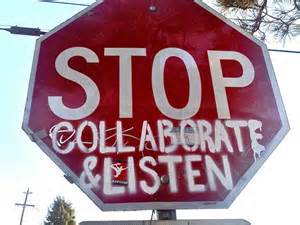
Take Back Islam: No More Double Standards Part 1

Take Back Islam: No More Double Standards Part 1

Written by Stephanie Siam

The Double-Standard Dilemma: Part I

Jennifer* was a convert Muslimah. Though she had only recently reverted to Islam, she was always a modest young woman, trusted wholly by family and friends.

About a year after her reversion, she met Ali*. He was a few years older than Jennifer, but since she had always been an “old soul” she was okay with the age gap. After meeting with him a few times, under halal (permitted) conditions, they agreed to marry. She had asked him every question that came to mind about their respective roles as husband and wife, but because of her conservative pre-marriage lifestyle, Jennifer assumed the basic routine of day-to-day living would remain generally the same for her.

One evening Jennifer made plans with a friend for dinner. Prior to going out, she let Ali know her plans, as he was also going out with friends for the evening. As she wrapped her hijab, Ali popped his head into the bedroom.

Jennifer looked at his reflection in the mirror and smiled. “I’m excited to see my friend. I haven’t seen her since college. We used to sit together for hours, just laughing and talking.”

“I’m leaving now. What time are you meeting her?” Ali leaned against the frame, crossing his arms over his chest.

“About seven. Great! So we’ll probably get back home around the same time, I’m guessing.” She stuck a final pin into the side of her scarf, grabbed her bag off the dresser and turned to leave.

“No. I’ll probably be late. Maybe around eleven or later.”

Jennifer walked over to him and patted him on the cheek. “Me, too. I told you. . .we can sit for hours.”

Ali shook his head and laughed. “Are you serious? No way.”

She stepped back, confused. “No way what?”

“No way about you staying out until eleven. That’s no good. Women shouldn’t be out that late.”

Jennifer laughed to herself. “What do you mean? I’m not going out to a club. I’m eating dinner, sitting with my friend in a restaurant. Besides. . .you said you’d be home around eleven or later. What’s the difference?”

“The difference is I’m a man.”

muslim_man_and_woman_by_agent_ea-d2xhuea
ONE NIGHT ONLY: Woman vs. Man!


And so it starts. The beginning of a recurring theme running through many, many marriages.

The double standard.

Of course, we can’t just limit this to Muslims, or even Arabic culture (a major contributing factor to this issue to begin with). However, for the purpose of this blog, I am only looking at the concept of double standard within Islamic-based marriages. To focus discussion even further, I will limit my scope of criticism to three areas of double standardization:

  1. Expressing Anger
  2. Working Inside the Home
  3. Working Outside the Home


Expressing Anger

 

lucy and ricky

Somebody got some ‘splainin’ to do!

For those of you familiar with the I Love Lucy Show, the image above most likely conjures memories of hilarious scenes between the title character, Lucy, and her Cuban-imported husband Ricky, wherein Ricky spends a great amount of time chiding his naïve and childishly-scheming wife in a mixture of Spanish and heavily-accented English while wagging his finger in a patronizing manner.

This is met, in return, by a loud, whining, “Waaaaaaaaahhhhhhh,” by Lucy, who offers the iconic phrase with closed eyes and a wide-open mouth. Add in the later Technicolor effects of Lucy’s bright red hair and unmistakable lipstick and you’ve got one funny picture.

Of course, if you take a step back and look at the bare-bones story, you see an overly-patriarchal husband chastising his younger wife for something that may-or-may-not be completely her fault. (Well, to be honest, in Lucy’s case, it usually was her fault.)

But the point is, in watching the exchange between the animated couple you hardly ever see Lucy stand up to Ricky. She takes everything he dishes out with a (mostly) closed mouth. And even when she tries to get the upper hand, she does so in a silent, action-oriented manner. . .that often backfires (poor Lucy!).

For those of you who aren’t familiar with the show, you may be wondering why I’ve brought it up.

Because this model is played out in many modern Muslim marriages, in the spirit of “heading the household”, the stronger, usually male, personality takes over and expects all to follow his way.

Western female converts know this posturing all to well. Her more-likely-than-not foreign born husband or even her community believes that the her conversion has been a way for her to escape a “hellbound” culture of capitalism, consumption and hedonism. Clearly, when we become Muslim, there is no desire to maintain any ties to our own cultural identity. . .or we wouldn’t have converted, right? *Sarcasm*

sarcasm

For most, the first sign of the “elite male status” rears its ugly head during the first argument. Let’s assume, for the sake of argument, both husband and wife are converts (this gets rid of the sticky “in my culture” issues that always come up in an intercultural relationship).

Since we understand couples argue for a variety of reasons ranging from stupid to life-altering, let’s say the water bill didn’t get paid, and now the water has been disconnected. This wasn’t due to lack of funds. It was simply due to oversight by one or the other.

What follows is a typical experience for many female converts in terms of arguing with a spouse:

Husband: There’s no water. What’s wrong with the water?

Wife: I don’t know. Maybe the whole building has a problem?

Husband: I’ll ask the neighbor. (Leaves to ask neighbor. Returns.) They have water. It’s just us.

Wife: Maybe the pipe’s broken?

Husband: Did you pay the bill?

Wife: Was I supposed to pay the bill? Don’t you usually take care of that?

Husband: Did you remind me? Let me go see if the pipe is fused. (Leaves. Returns.) They fused the pipe.

Wife: I guess the bill didn’t get paid.

Husband: Why didn’t you remind me? I have a lot of things to do.

Wife: I also have a lot of things to do. I suppose I didn’t think about it.

Husband: That’s the problem. You don’t think about things that are important.

Wife: Of course I do. I’m just not used to thinking about things that I don’t usually take care of. Since you always pay the bill, I didn’t think about it.

Husband: A good wife reminds her husband about important things.

Wife: So, now it’s my fault because you didn’t remember?

Husband (raising voice): It’s your fault because you didn’t remind me!

Wife (raising voice in response): I’m not your secretary! Can’t you make a note of important things?

Husband (yelling): Don’t raise your voice to me! I’m your husband, and you must show me respect!
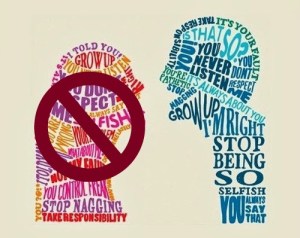
This is not ok
This is not okay

Wife (yelling back): Well, I’m your wife! Don’t yell at me!

Husband (increasing in volume): I am your husband, and I have the right to yell! But you will not speak to me this way! Do you understand?

Now, depending on the general temperament of the man and woman, this episode will escalate further with both getting out of control, or one person will eventually back down. But the question is: why does the husband believe it to be okay for him to raise his voice at his wife, but not for his wife to raise her voice in response?

Why are women – especially Muslim women – expected to be demure and soft-spoken, even when being yelled and cursed at by the person whom they are supposed to respect and trust most in the world?

Why are men allowed to give in to their human characteristics of anger and displeasure, while women are labelled “emotional” and told to contain their feelings?

It is only natural to want to respond in kind to someone when they verbally attack you, be it through volume or vocabulary choices. However, this is considered taboo, inappropriate or disrespectful of men when women get upset and show their feelings.

What ends up happening is that over time, the woman will start to exhibit traits of an emotional or psychological abuse victim. She will withdraw at the sign of argument, afraid to stand her ground, even when she is right to do so. Her opinions will become invalid, even to herself.

She will contain all feelings, positive and negative, until pent-up aggression and expression will cause her to be overcome with anxiety. And then she will not know where the anxiety stems from, as she’ll end up letting her emotions fly at the most mundane of incidents (see: opening a blister package for medication).

So, what’s the solution? Should women be able to yell back? Are women allowed to yell back? Are they allowed to get angry? To show their emotions like men do? Is it really the man’s right to dominate the situation and demand sovereignty in decision-making?

Rasoulallah.net reports:

Once, Aisha was angry at the Prophet – peace be upon him – so, he told her: do you accept Abu Obaida Bin Al-Jarrah as a judge between us? She replied: no, this man will not issue a judgment against you in my favor. He said: do you accept Omar as a judge? She replied: I fear Omar. He said: do you accept Abu Baker (her father)? She replied: yes I accept him.

This exchange shows that no matter how he viewed his own opinion in the matter, even Prophet Muhammad (saw) acknowledged his wife’s right over him to be fairly heard and express her feelings.

He didn’t yell and say, “I don’t care what others think. It’s my opinion that counts.”

Nor did he demand they go to the first person he suggested as a mediator. In fact, he didn’t stop offering names until he found one she agreed with. So, even in their disagreement, he wanted to make sure he found someone who would support her and be fair in their decision about the disagreement.

Additionally, Pakistani freelancer Sadaf Farooqi explains in his article discussing an incident where A’ishah (ra) was verbally attacked by her co-wife, Zainab (ra), in her own home :

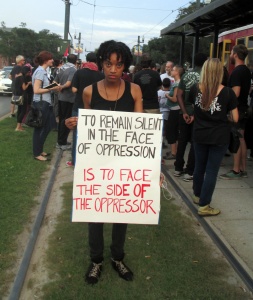
He [Muhammad (saw)] did not – and this is a very important key point – exhort the wronged person to keep silent in the name of patience and restraint. He did not allow their oppressor to continue with their injustices. Rather, he made sure that the wrongdoing was not just stopped, but that the one who was wronged also defended themselves.

Even though Zainab (ra) was older than A’ishah (ra), the Prophet (saw) gave his approval for her to speak up about what was being said against her.

Truthfully, the answer is not in who is allowed to yell and who is not.

The answer lies in open communication. Understanding the right that both parties in a marriage have for expressing their opinions, being heard and trusting their partner with protecting (through mutually respecting) their feelings.

One person or the other dominating a relationship and holding the other emotionally hostage is the very definition of dysfunction. As we can see from the example, even our Prophet (saw) permitted his wives to have their say and defend themselves in an argument.

Instead of fighting – yelling, screaming, cursing or worse – couples must learn what works best for each of them when they’re upset or angry. This can take time, but the best answer is being open and honest.

If you need to blow off steam, that’s fine. But make it clear to your spouse this is needed. And then get away from them. It’s okay to unwind and calm down. It’s not okay to do it at the expense of another person’s well-being. And it is even more NOT OKAY to say that just because you are male Islam gives you the right to be an emotional bully. . .or worse.

*The couple mentioned in the story at the beginning are fictitious. Any similarity or resemblance to real people is unintentional.

Follow us (upper right of the page), email us (islamwich@yahoo.com), like our face with your face on Facebook, like the post, share it, pin it, comment on it, and/or do whatever social media magic it is that you prefer. Find out more about us in the understandably named “About Us” page and browse other posts in our “Table of Contents”.


What Would the Prophet Do?

What Would the Prophet Do?

Written by Stephanie Siam

As a human, I am deeply saddened by the tragedy that occurred in Paris this week. This senseless – yes, SENSELESS – act of violence will only serve to perpetuate greater global discord. Muslims around the world are now scurrying about in their PR hats doing damage control against the ignorant masses who still do not comprehend that the few involved in this heinous attack are no more acting on behalf of Islam than the Westboro Baptist Church acts on behalf of Christianity.

Case in point: A neighbor of Prophet Muhammad (pbuh) used to leave trash on his doorstep every day because he hated him (he wasn’t Muslim). One day, the Prophet went outside and noticed there was no trash. What did he do? He called upon his neighbor to find out why he hadn’t left any garbage at his door. It turned out the neighbor was sick. So, the Prophet sat with him a while to bring him good cheer in his illness.

Moral: If Prophet Muhammad himself didn’t retaliate against those who disrespected him by doing things much worse than drawing a picture, what makes anybody think they need to “avenge” him?

Upon Prophet Muhammad’s death, Abu Bakr (one of his greatest companions) said, “For those of you who worship Muhammad, he is dead now. He was just a man. For those of you who worship God, He will never die. He is eternal.”

It is important to remember the teachings of the Prophet (pbuh):  For those who take the life of an innocent person, it is as if they have killed all of mankind. And for those who save the life of an innocent person, it is as if they have saved all of mankind.

Which would you rather be claimant to on Judgement Day: saving all of mankind or destroying it?

I understand why Muslims feel offended by images of Prophet Muhammad (pbuh). Physical replications of the Rasool (prophet) are forbidden in Islam. Therefore, seeing drawings of him is offensive to many Muslims … especially when he’s got a turban full of TNT on his head. Or, astigfur God (may God forgive me), he is sans clothes in compromising positions with other people.

But, ironically, I don’t understand why other atrocities that are forbidden in Islam aren’t met with such fervent intolerance.

For example, we aren’t allowed to depict God, either; how could we? Nobody knows what God looks like.

Does this outrage you?

Yet, I haven’t heard of any Muslims getting in an uproar over Michelangelo’s Sistine Chapel painting portraying Adam and God touching hands.

And what about the cartoonization of Prophet Isa (Jesus, pbuh) on shows such as South Park? Why aren’t Muslims rallying for the destruction of this demeaning and offensive representation? It isn’t simply that drawing Prophet Muhammad is off-limits.

ALL of the prophets (literally innumerable, as God tells us in the Qur’an) should be revered, respected and not characterized by humans or sketches.

When I hear a joke that starts to include God, I like to change the subject. If I see a caricature of a highly-esteemed religious figure, I don’t laugh and promote it. I get bristled. I want to destroy the picture – by tearing it up and throwing it away.

But I don’t feel the need to punish the offenders. If you can even call them offenders.

See, the Qur’an calls for punishment of those who commit adultery. But we don’t see Muslims raiding homes. Killing men and women who have relations outside of marriage so as to protect the sanctity of Islam.

Those who get intoxicated in public are reprimanded and disciplined. But there are only a few dry countries in the world. And those that are dry know very well that their nationals depart to other countries along the borders on the weekend to fulfill their wants and needs.

Children, women and the infirm are dying – RIGHT NOW – in so many countries around the world. They are starving. They are homeless. They have no water. They are freezing to death. TONIGHT.

Does this outrage you?

Where are the outraged Muslims demanding their governments do something to change the status quo?

Because these are ALSO forbidden in Islam: adultery, alcohol, and ignoring the needy.

Do you know what the Qur’an does not sanction? Murdering people for drawing pictures of somebody you love.

Yet, there are still Muslims (and BY FAR NOT THE MAJORITY) who believe the most pressing issue in the world is some cartoonist in France who draws a cartoon of a religious figure.

Why do you think this is?

I think the answer lies within Abu Bakr’s wise words. Like Christians of the past and present, too many Muslims have departed from the path of righteousness. They have raised Prophet Muhammad (pbuh) to a status greater than what he was. Islam is about following the Qur’an and the Sunnah (teachings of the Prophet). But it absolutely forbids associating anybody with God. Yet, it seems many people have come a hair’s breadth away from committing this grave, unforgiveable sin (shirk).

I am reminded of a picture – an actual photograph – I saw online in conjunction with this story. It was an image of a

Does a crime against Islam actually exist?

poster that displayed several men’s names who were “WANTED: DEAD OR ALIVE FOR CRIMES COMMITTED AGAINST ISLAM”.

When I read those words, I couldn’t help but ask, “What are crimes against Islam?”

I understand crimes against man: murder, theft, assault.

I understand sins against God.

But I don’t understand how someone commits a crime against a religion.

There is nothing in the Qur’an that justifies killing someone because they don’t believe the same thing as you. There are appropriate punishments prescribed for crimes against man, as well as sins against God that promote the demoralization and collapse of society.

But sins against God in terms of belief and submission?

Those are not ours to punish for. We can not, nor are we permitted to, compel others to follow a teaching when God has not willed it. There is no compulsion in religion.

With that being said, I want to reaffirm my intense alarm and disheartening at the deaths of the Charlie Hebdo staff members. But I will not apologize for my beliefs or my religion. Islam does not support indiscriminate revenge in the name of God, Prophet Muhammad or anyone else. And I will not allow Islam to accept the blame for the actions of peaceintolerant, hatemongering humans.

Hate begets hate. Peace begets understanding.

I choose peace.

Assalamu alaikum.

Originally posted on CNN ireport.

You can also read Theresa Corbin’s CNN ireport here

Follow us (upper right of the page), email us (islamwich@yahoo.com), like our face with your face on Facebook, like the post, share it, pin it, comment on it, and/or do whatever social media magic it is that you prefer. Find out more about us in the understandably named “About Us” page and browse other posts in our “Table of Contents”.

2-1/2 Cents of a Convert’s Life

2-1/2 Cents of a Convert’s Life

Written by Brother John Matthew

The following is a story that some Muslims consider controversial. That’s good. Controversy among intellectuals stimulates discussion; which encourages progress.

The time is the 1980s. Smartphones didn’t exist and computer monitors still came in monochrome. The place is the Big new york in the 80sApple. It’s summertime hot; in an area filled with old cookie cutter brownstones, project housing and single family homes; a fantastic menagerie of people, places and income separated by parks and patches of commerce; all wrapped up in a well designed layer of concrete under the vast skyline.

African American, Latino, Oriental, Middle-Eastern and White all rolled up into one super ecosystem of human diversity; that is the beauty of places like New York. People from all over the world live side by side with very little problem considering the millions that live here. I was in my late teens; a whole 125 pounds of lean bone like muscle soaking wet; a homegrown American and as apple pie as one can be. On this particular summer day my life would change forever.

I made my way by foot past various 1950s style brick housing over to my relatives’ apartment which was about 5 blocks from my house. As I was hanging out in front of the complex this young girl caught my eye. Like any normal teenage boy, I did everything I could to get her attention.

From the logical, to the absurd and though she was very reluctant at first, I slowly was able to scratch the surface and I was blessed to get to know more about her. The more I came to know her, the more I fell deeply in love. She was a very religious, intelligent, enormously kind, thoughtful young lady from a part of the world I had barely read about in the news.

During our communication I learned more and more about Islam, (becoming more intrigued and closer to Allah than I ever was) and the people of her land. She worked very hard to educate me on Islam and her culture. We worked very, very hard to convince our families to acknowledge our desire to move forward together.

We tried to do the right thing, though our relationship caused both sides great pain. I cannot write to you that we are star_crossed_lovers__by_francesholly-d3ha8l0together today. Not all great love stories have happy endings. The cultural differences and other highly complex social factors that even now require deep study; were ultimately too much for the two of us to overcome; thus is the will of Allah. After several years of struggle our relationship was no more.

It fell victim to cultural bias. It is until this very day; one of the most difficult periods of my life, full of wonder, joy, sadness, hope and despair. Out of it all, I learned more about her welcoming and generous part of the world, more about love and more about introspection than probably 99% of young persons at the time.

Most of all I became closer to Islam and in fact during our time together I took Shahadah with an area Imam;  I became what is traditionally known as a convert.

I am conveying my story to  you so that you will know that the advice that is to follow comes from an authentic source. A source that has lived the life from which the advice originates through the will of Allah, with the best of intentions to help you if you should require and desire it. Read it well and take it to heart. Insha’Allah  it will benefit you.

“In the name of Allah, the Most Gracious, the Most Merciful”

  1. Allah’s guidance is unending; without exhaustion, without limit.

    Allah’s’ lessons can take a lifetime to play out in your mind. It is incumbent upon you as a Muslim to continue to learn from your experiences and use them to grow as a gentle, tolerant human being practicing the faith of Islam. Just as a Doctor practices medicine or an Attorney practices law; do not forget that one “practices” Islam because there is always room for learning and improvement.

  2. Allah’s gifts are not to go unopened.

    If you are a person in a mixed Muslim relationship; Muslim in love with a non-Muslim or a  non-Muslim in love with a Muslim; Allah has brought you together for a reason. Allah is all merciful and kind. Use your gift of love to become closer to Allah and your love for each other will grow strong; helping you to fend off doubters. Seek out a well versed, experienced Imam and talk to him about your situation. Ask for guidance. Do not and your love will not.

  3. Allah places great indescribable value on women.

    Anyone that thinks otherwise is not an educated Muslim.  I was personally introduced to Islam through the love of a women. I can think of no higher an indication than that.

  4. You must use your faith to help others.

    At some point in time during my experience as a youth, if someone, anyone would have stepped in and took care of our young souls, through the teaching and love of culturally unbiased Islam, I can’t help but think that we would have been able to overcome our challenges. Allah provides us with the tools in Islam, but we must use them well and help those less educated and experienced. Seek guidance from others.   

  5. Do not use Islam or your culture as an excuse to push people away or to reject others.

    If you think you are better than someone because you are Muslim with a different culture and they are not the same as you; you are arrogant and prejudice. You are ungrateful that Allah has chosen you and not them. Being grateful is to recognize your gift and to make attempts to gift it to others. Use the teachings of culturally unbiased Islam as a platform for communicating it’s beauty and benefits to others who will listen. If your enemy approaches you with arms down, stay alert but use that opportunity to build love and trust and soon that enemy will be your enemy no more. That is real victory.

Insha’Allah this text will help you as you navigate the wonders of this life.

–  Brother John Matthew

Follow us (upper right of the page), email us (islamwich@yahoo.com), like our face with your face on Facebook, like the post, share it, pin it, comment on it, and/or do whatever social media magic it is that you prefer. Find out more about us in the understandably named “About Us” page and browse other posts in our “Table of Contents”.


islamwich’s 2014 in Review

islamwich’s 2014 in Review

Written by Theresa Corbin

As we face the end of the Gregorian calender year, I find myself thinking it wasn’t enough time. Somehow this year was shorter than all the previous years. And those previous years were shorter than their predecessors, and so on in an ever shorter year-scape.

But mostly, I think that I just get slower as the years pass. Or lazier. It is hard to say which, and collecting the data to determine whether I am slower of just lazier seems like too much work.

So as a tribute to a year that has passed too quickly, let us remember with fondness some stuff that went down here on islamwich.

We made some new friends!

Siam, I am
Siam, I am
Elmasry the Artisan
Elmasry the Artisan

We collaborated with other bloggers.

a joke for those of us who survived the 90s.

We started discussing the serious stuff with our “Take Back Islam” series. 

Take-Back-Islam

We raised money for good causes in Ramadan with our “Ramadan Giving” series.

donations

We tried out bylines … But they annoyed everyone, so we 86’d them. YOLO!

gracie-byline
bye, bye, byline

We protested the assault on Gaza. And we continue to protest the occupation.

New Orleans stands with Palestine protest on Aug 1. Protestor holds her sign to show support.

We shared some recipes– and rewrote some to make them halal.

halal gumbo

CNN brought a lot of traffic our way.

Me on CNN

We demystified some Quran.

quran.karim by lechistani

We tried our hand at humor. We complained about culture clash and promoted understanding. We wondered when we would ever get over our Pinterest addiction (never! why would we?).  And we did so much more. But still, it seems as if we were short on time.

What’s to come in 2015?

Look for more guest posts- written by those with different perspective on the Muslim ‘merican experience.

Look for me, Corbin, on Bela Hodood (“without frontiers”) on Al-Jazeera in January.

Come on down South to the beautiful city of Memphis were I will be giving a speech entitled “An Open Invitation to Understanding Islam and the Muslims” in March. Update: too late! But you can watch it here.

Stay tuned for more of my serious series “Take Back Islam” and foolhardy attempts at comedy, more narratives from Siam, more fun and friendly lists from Lawrence, and more islamwich beautification from Elmasry.

Follow us (upper right of the page), email us (islamwich@yahoo.com), like our face with your face on Facebook, like the post, share it, pin it, comment on it, and/or do whatever social media magic it is that you prefer. Find out more about us in the understandably named “About Us” page and browse other posts in our “Table of Contents”.

A Lesson Learned from Omar

A Lesson Learned from Omar

OmarWritten by Theresa Corbin

It is a hard story for me to talk about for many reasons. It brings back bad memories and puts me and my family in a suspect light. But I know that people can benefit from the lesson of Omar Hammami’s journey and death.

It is a cautionary tale.

Many people try to paint him with broad strokes. The FBI called him one of their most wanted. CNN called him a Jihadist rapper. Fellow jihadis call him a hero: those were the same people that later killed him. He called himself Abu Mansoor al-Amriki.

To me, Omar Hammami was a kid. I met him when I was first introduced to my husband to be. In those days my husband, Omar, and a few other convert brothers travelled together in a pack. Omar, while one of the youngest pack members, was often the loudest and most energetic.

A scraggly-bearded teenager in thobes, Omar was a frequent guest in my home where he would chat for countless hours with my husband, share meal with us, and on occasion eagerly offer his help when we were in a bind. He was a good friend to my husband and me.

But in his experiences from Alabama to Somalia, Omar became the perfect mix of an impassioned, angry and frustrated young man.

Read the rest of my article at OnIslam.net to find out how Omar fell prey to radical ideals, joined a terrorist organization and was murdered by that same organization, and why it matters.

Follow us (upper right of the page), email us (islamwich@yahoo.com), like our face with your face on Facebook, like the post, share it, pin it, comment on it, and/or do whatever social media magic it is that you prefer. Find out more about us in the understandably named “About Us” page and browse other posts in our “Table of Contents”.

Converts and the Holidays: Maintaining the Ties of Kinship without Crossing Islamic Boundaries

Converts and the Holidays: Maintaining the Ties of Kinship without Crossing Islamic Boundaries

Written by Stephanie Siam

I remember as a kid sitting in my family’s living room:

memories
memories

All the lights off, all the sounds off, watching the lights on the Christmas tree move through their rotation of red … to blue … to green … to white … with the decorations glistening in the electric glow. And then they rotated to off. And for a moment I held my breath, waiting for them to come back on, bringing me out of darkness, into a room of warmth and color.

I remember the first Christmas after I converted to Islam:

I was conflicted about what to do. I lived in the same city as a lot of my extended family. My immediate family was driving to Mobile for the holidays. There was a schedule of who to visit and where to go in the short time they were to be in town. And nobody knew I was Muslim.

The holidays – especially Thanksgiving and Christmas – have always been a kind of family reunion for my mother’s side of our family. When my grandmother was still alive, the dinners and get-togethers always centered around her house. With my mother at her side, she crafted delicious meals and traditions that still hold a soft place in my heart.

After her death, these two occasions became even more important to my mother. She needed to continue the tradition. She needed to feel like nothing had changed. And I didn’t want to be the one to break her heart.

Still, everywhere I turned, all I heard was, “Haraam. Haraam. Christmas is haraam.”

Do not try this at home

Now, before you jump the gun and assume I’m proposing Muslims deck the halls with holly to have a merry little Christmas – hear me out.

It makes very little sense to me for Muslims born outside of countries that celebrate Christmas (or natural-born Muslims, for that matter) to participate in festivities that are foreign to them. For example, even though Kwanzaa and Hanukkah are observed in the United States by people of their respective heritage and traditions, not all Americans take part in celebrating these occasions.

And unless someone converted to the observing religion or became part of a family that practiced such traditions, most people would think it strange for a person to participate in a festival outside of their own religion or family/cultural tradition.

So, with that being said, it is easy to see why many scholars lay out the blanket “Christmas is haraam for Muslims” statement, especially those that have never been outside of their own countries or experienced multiculturalism in their own lives and families.

Some of these same scholars also say it is “haraam” for women to drive cars, air conditioners to be used in the absence of husbands at home, and a person to change his religion. However, there has been much research and discussion about all of these, and other scholars have permitted the same things that others forbid.

While I understand the basis for scholars to say Muslims shouldn’t celebrate Christmas and its traditions – the purpose of Christmas, the religious affiliations it has, and the consumerism it promotes – to issue an all-encompassing ruling that also cuts ties between Muslim converts and their Western families is dangerous.

Most people are well-aware that Christmas has long since left its original “adopted” purpose (the birth of Prophet Isa/Jesus [pbuh]) and become more of a secular winter festival celebrating snow, Santa Claus, and uncontrolled spending. Even if there are religious aspects of the holiday still observed by families, they hardly ever take place on the day of the celebrations – unless it falls on a Saturday/Sunday – and they are not usually at the forefront of the occasion.

The truth is, Christmas has become a secular, cultural tradition where families get together to socialize, eat and make memories.

family, food, and fun (or fights)

Accordingly, many Muslims who converted from Christianity understand this. Many converts from other religions (or none of them) also get this picture. The ones who don’t seem to understand are the scholars issuing fatwas (religious rulings) on issues outside the scope of their culture or experiences.

Again, let me be clear:

I don’t think it is okay for Muslims (natural-born or converts) to go to church and praise services in celebration of Christmas. To attend Christmas mass, Christmas Eve prayers or take part in the Christmas cantatas (live depictions) of the Nativity (the Biblical account of Jesus’ birth) – no matter how much we Muslim ladies resemble the Virgin Mary – is not cool. Or Islamic. In fact, it’s probably bordering on shirk.

But there’s an issue that natural-born Muslims don’t understand – and quite often judge – about us converts. Despite adopting a new religion, embedding ourselves in foreign languages and cultures, and attempting to reconcile our previous lives with our new ones, we still have family members. We still have people that love us – or at the very least want to understand us.

And the beauty of Islam is that even though we’ve accepted this new way of life and worship, we aren’t supposed to cut ties with the ones who birthed us, raised us, supported us and loved us from the beginning.

OnIslam respondent Dr. Jamal Badawi, Member of the European Council for Fatwa and Research (ECFR) and the Fiqh Council of North America, explains:

Participating in the non-religious aspect of Christmas such as family reunion dinner or visitation is OK. Attempts should be made to avoid situations where alcoholic drinks are served on the same table. Kindness to parents and family without compromising one’s beliefs is an Islamic duty.

During socialization and whenever appropriate, one may share one’s thoughts [on religion] with them, preferably in answer to their questions or comments without being too argumentative.

In fact, in terms of greeting others and giving gifts: this is actually sunnah (actions recommended/practiced by Prophet Muhammad [saw]). No, I am not saying the Prophet (saw) brought Christmas gifts to his Christian neighbors. However, Allah (swt) does instruct us to return greetings to others in kind or better:

When you are greeted with a greeting, greet in return with what is better than it, or at least return it equally… (An-Nisa 4:86)

Additionally, the European Council for Fatwa and Research suggests this action becomes obligatory when non-Muslims congratulate Muslims on the occasion of Eid al-Fitr or Eid al-Adha. Therefore, if your neighbors customarily acknowledge you on your Islamic holidays, it is perfectly okay to wish them well on theirs in the spirit of maintaining community and friendship.

With regards to gifts, the ECFR explains:

There is also no objection to accepting gifts and presents from them, and to return their gifts in kind, on

I love a presie anytime of year!
I love a presie any time of year!

condition that these gifts are not unlawful in themselves, such as being alcohol or pork. The Prophet (peace and blessings be upon him) accepted the gift of the King of Egypt and several others [. . .] .

Interestingly enough, the person who had the most influence (beyond Allah, alhumdulillah) in my conversion to Islam gave me a Christmas present the first year I knew her. I remember this action often, as it reminds me of how I was invited into Islam in a gentle, encouraging manner — the way we should bring others.

Finally, one of the first things Muslims learn as a child is the status of mothers in Islam. It does not differentiate between the religion of mothers; the only stipulation is the mother cannot enjoin the child to go against Allah. This means, while you must respect and obey your mother and father, you must also remain true to Islamic teachings.

If your parents are trying to force you to go to church with them, or to remove your hijab, or drink alcohol or eat pork, then you should certainly avoid these situations. But if your parents only want you around to visit with them, to share in memory-making as a family, to eat some yummy food and enjoy a nice cup of apple cider by the fireplace, why isn’t this okay?

Idris Tawfiq, in his article “Happy Holidays”, best expresses my sentiments when he says:

If we know in our hearts that we are not celebrating the religious side of the feast, perhaps even declaring this in our own du`aa’ [sic] on the morning of Christmas itself to reassure our newfound faith, we have nothing to fear by taking part in a celebration of family and friends.

Indeed, there are several varying opinions on this issue. I am not saying that one opinion is more correct than the other. However, when it comes to me, I take the side of strengthening the ties of kinship, showing my relatives the positives of Islam (such as generosity, kindness to family and respect for others’ opinions and faiths) and praying that one day, we can all celebrate Eid al-Fitr together. As Muslims, insha’Allah.

Note: My intention with this article is not to encourage Muslims to start decorating their houses with lights, putting up trees in their living rooms or singing Frosty the Snowman when the first snowfall comes. If anything good comes from this article, it is from Allah. And if anything wrong appears, it is from me. And I ask Allah to forgive me of any misunderstanding I have or cause.

Follow us (upper right of the page), email us (islamwich@yahoo.com), like our face with your face on Facebook, like the post, share it, pin it, and/or do whatever social media magic it is that you prefer. Find out more about us in the understandably named “About Us” page and browse other posts in the “Table of Contents”.
Advice for Young, Marriage-Minded, Muslim Men

Advice for Young, Marriage-Minded, Muslim Men

Howdy, folks. This week on islamwich, we have a special guest writer- Brother Abu Taurab. Abu Taurab is a Southerner who converted to Islam at the ripe old age of 16. He now spends his days working in the renewable energy field and his nights making gourmet meals for his wife and hanging with his two gorgeous children- ages 3 and 18. Abu Taurab is here to share some of his wisdom about getting married.

Written by Abu Taurab

abu taurabGrowing up as a teenager in a small, tight-knit Muslim community in the South (of the US) there were four of us young mosque rats from the area, two converts (me included) and two born into Muslim families. The small community had its pros and cons. On the one hand, all of us young men were close and encouraged each other to do good. We really stuck together. On the other hand, when it came time to get married, opportunities were slim.

All of us ended up searching far and wide for partners. The journey to marriage varied in difficulty for each of us as did the continued journey. Here is some unsolicited advice on getting married that I gleaned from our groups’ mistakes experiences:

1. Covert Relationships

There is a very good reason we are supposed to stay away from flings with members of the opposite sex. Dating sucks. It involve intense emotions, potential for offspring, and monetary loss; things that should never mix without a contract protecting all involved. I have seen religious friends become caught up obsessed with a member of the opposite sex. They created secret email accounts and shared the login and password, saving messages to each other in the drafts folder. It’s the kind of OP-SEC you expect to see in spy drama.

Don’t fool yourselves, getting emotionally involved with someone means you are walking a thin line. I have not met many people who actually ended up marrying that same person with whom they shared secret missives in the night. Keep in mind, that other person will probably end up marrying someone else. Protect your honor and her honor and just don’t.

2. Parental Road Blocks

Be patient. I have seen many parents stand in the way of their children getting married, demanding that they finish school

because 18-25 years old know everything.

first. If this is true for you, this is not because your parents are not religious and that they don’t care about whether or not you commit zina (unlawful sexual relations), as is often assumed. Give them the benefit of the doubt. They are older and wiser. They want to make sure you are able to provide for your family. Of course, the provision is from Allah but the effort is from us. That effort means preparing yourself for a career or profession.

How often do you think your wife will want to get busy if you are homeless and starving? Trust me from personal experience, marriage is hard enough without worrying about where you will get your next meal or how you will pay rent.

Now there are extreme situations, emphasis on extreme, where a parent will not let their child get married no matter what, in which case it is a different story. If you are in this situation, then seek out the counsel of your imam or another elder in your community whom you and others trust.

3. Wali Woes

Do things the right way. Make sure the father or wali (family representative) of your intended partner is on board. Back room dealings leave important people in the dark and that usually gets messy. When marriage is on the table, you are not just marrying a person,you are becoming a part of their family. If you don’t show respect to her family as well as yours, how do you think future relations will be? It is a recipe for strained Eid gatherings and Aqiqah (celebration for newborns) weirdness, among other things.

Remember that your future wife’s wali is not trying to control her life, in all likelihood he wants what is best for her (and so should you) and is looking out for her interests. You may be able to charm the girl, but the wali will be able to keep some sense about him.

4. Looking for a Looker

niqab model
She’s a doctor and a model, but all she really wants to do is have your children while you play video games and get fatter. Get a grip, brothers.

Marry for religion and not looks. Many a brother is looking for a highly educated, super model and gourmet chef who has memorized Quran and wears full niqab (face veil). But how often does the same brother measure up to those impossible standards? Not often if ever. Yes, a man should be attracted to his wife and vice versa. But for all of us, the beauty of youth will fade. And a woman with beautiful iman (faith) will always be beautiful.

The honeymoon phase eventually ends and you want to be with someone who will fear Allah (taqwa) and be good to you even when they are not happy with you. Trust me, there have been times when my wife would have shanked me if it wasn’t for taqwa. I don’t know about you, but I personally don’t want to be in a marriage that has prison rules.

Most importantly, once you do get married, forget all the crap that other young, unmarried brothers told you about marriage. She is NOT your slave and baby maker, but rather a partner and a potential best friend. Respect her, be good to her, and be gentle. Overlook her faults and mistakes and especially her bad hair days. She is trying just like you. Remember, in the end you both have the same ultimate goal … Making it to Jennah (paradise).

Follow us (upper right of the page), email us (islamwich@yahoo.com), like our face with your face on Facebook, like the post, share it, pin it, and/or do whatever social media magic it is that you prefer. Find out more about us in the understandably named “About Us” page and browse other posts in the “Table of Contents”.