Image

Talking in Memphis

I love Memphis
New Orleans is awesome, but Memphis is giving the “Big Easy” a run for her money.

Written by Theresa Corbin

A couple of weeks ago, I gave a talk inviting people to understand Islam and the Muslims in Memphis, TN. I had many fears before going to Tennessee. Having read about anti-Muslim sentiment in Murfreesboro, TN, I fully expected to be shot.

I went anyway. And instead of hostility, I found the Memphian community full of interfaith camaraderie. I found Muslims working hard to enrich their community and create an atmosphere that fosters understanding and cooperation. I found warm and welcoming non-Muslims who greeted their Muslim neighbours- and me!- with big smiles and kindness.

My experience in this amazing community has enriched my life (and my waistline. Their BBQ ain’t no joke) in so many ways I cannot even begin to explain.

In order to raise awareness about my talk, I had the opportunity to speak about my topic in interviews on TV and radio.

What follows are my interviews:

On TV: WREGClick me: WREG

On Radio:

* Hajar’s son’s name was Ishmael (Peace and blessings be upon him).

**please note that Sarah was not the one who made Abraham leave Hajar in the desert of Mecca. This was a directive from God. I just learned this and feel embarrassed that I let my former Christian understanding of the story — that can be very misogynistic (Eve responsible for the first sin. Not true in Islam)– shape my attitude toward Sarah. 😦

I hope to post the video of my talk “An Open Invitation to Understanding Islam and the Muslims” next week. So stay tuned!

Follow us (upper right of the page), email us (islamwich@yahoo.com), like our face with your face on Facebook, like the post, share it, pin it, comment on it, and/or do whatever social media magic it is that you prefer. Find out more about us in the understandably named “About Us” page and browse other posts in our “Table of Contents”.


Image

Humor in Muslim Heritage?

humor in Muslim Heritage title

Written by Theresa Corbin

Originally published on OnIslam.net-

Did you hear the one about the Priest, the Rabbi, and the Imam who walked in to a bar?

Of course not! Imams don’t drink.

Bad jokes aside, most of the non-Muslim world imagines that Muslims live humorless and austere lives, never even cracking a smile.

Talk of Muslim scholars hearkens images of severe men in ivory towers handing down fatwas to a world they know nothing about – and admittedly and unfortunately sometimes this is true, but it is very far from the majority.

I hear it all the time. Every time I crack wise or show the lighter side of my personality, non-Muslims who happen to be in ear shot are always shocked and make it known that they didn’t expect me to be … gasp … funny!?

Confusion ensues, and I am written off as an anomaly. But this is so far from the truth it is not even … um, well … funny.

The Muslims have a long and hilarious history replete with a smiling and joking Prophet (peace be upon him), prankster companions, Caliphs who knew how to laugh at themselves, jokesters throughout the ages and even a long lost joke book written by revered scholar.

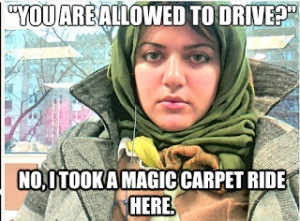
funny hijabi
We got jokes too!


A Smiling Prophet

Think of a Prophet, any Prophet. What comes to mind?

For most people, recalling a Prophet is to think of a man suffering in rags, living a sad and hard life.

To the Muslim, a Prophet is someone who is serious when the occasion calls for it, but is good natured and often found smiling. The Prophet Muhammad is often called the smiling prophet and many anecdotes of his joyful and smiling disposition are quoted in hadith.

One such hadith, Abdullah ibn Haarith said:

“I never came across a person who smiled as much as Prophet Muhammad. Prophet Muhammad regarded smiling to a brother as an act of charity.” (At-Tirmidhi, 3641)

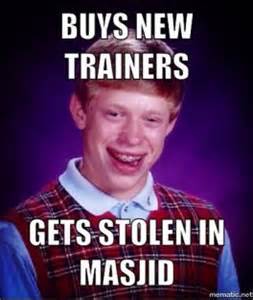
"trainers" is the brits' funny way of saying sneakers.
“trainers” is the brits’ funny way of saying sneakers.

He Could Make a Joke

Several instances can be found in the sunnah where the Prophet (peace be upon him) is cracking jokes with his companions and family.

“Once, an old woman came up to him [the Prophet] and asked for paradise. He said:

“Old women do not enter the paradise.”

The woman started crying. As she started leaving the room, the Prophet, showing his subtle sense of humor, stopped her and said:

“Old women will become young before entering the heaven.” (Shama’il Muhammadiya, 230)

He Could Take a Joke

Not only could he dish it out, but he could also take it.

Once a companion of the Prophet named Nuayman (who was a known prankster-may Allah be pleased with him) went to the market and saw some food being sold which appeared to be delicious.

He had some of it sent to the Prophet Muhammad as if it were a gift. The Prophet was happy to receive the lovely gift of food and he and his family ate it. The seller of the food then came to Nuayman to collect the money and Nuayman said to him:

“Go to the Messenger of God it was for him. He and his family ate it.” The seller went to the Prophet asking for the price of the food. The Prophet in turn asked Nuayman:

“Didn’t you give it to me?”

“Yes,” said Nuayman.

“I thought you would like it and I wanted you to eat some of it so I had it presented to you. But I don’t have any dirhams [an increment of money] to pay the seller. So, pay, O Messenger of God!”

The Prophet had a good laugh and so did his companions. The laugh was at his expense, literally, because he had to pay for the unsolicited “gift”.

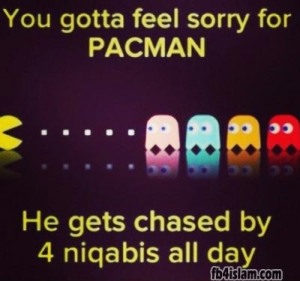
niqab = face veil naqabi = strong and brave woman who wears face veil.
niqab = face veil
naqabi = strong and brave woman who wears face veil.

His Companions Knew How to Laugh Too

The companions followed suit and didn’t take themselves too seriously. During the caliphate of Uthman after the Prophet’s death, a group of companions were sitting in the mosque. They saw Makhramah ibn Nawfal, who was by this time old and senile.

Makhramah got up to relieve himself and because of his blindness might have done so in the mosque. Nuayman (at it again) got up and went to take him to another place.

Little did Makhramah know, Nuayman had not guided him to the proper place but guided him to relieve himself in a place that was still in the mosque!

People shouted at Makhramah. The poor old man was distressed and said:

“Who has done this?” The people told him it was “An-Nuayman ibn Amr”.

The old man swore and announced that he would knock Nuayman on the head with his stick.

Nuayman left and returned. He was scheming again. He saw Uthman, the leader of the Muslims, performing prayer in the mosque. Nuayman also saw Makhramah. He went up to Makhramah, changed his voice, and said:

“Do you want to get at Nuayman?”

The old man shouted:

“Yes, where is he?”

Nuayman took him by the hand and led him to the place where the Caliph, Uthman, stood and said to him:

“Here he is!”

The old man raised his staff and beat Uthman. Blood flowed and the people shouted:

“It’s the Amir al-Muminin [meaning Uthman]!”

In spite of the blows he had suffered, Uthman was still able to laugh at the deeds of Nuayman.

He can do it. He's just goota be able to stand on his own first and know more Quran than everyone esle. Shouldn't be hard.
He can do it. He’s just gotta be able to stand on his own first and know more Quran than everyone else. Shouldn’t be hard.

Humor of Later Generations

This jovial tradition and pranking doesn’t end with the Prophet or his companions.

Tales are told of a hilarious man named Juha who lived in the 8th. century. Juha was a Muslim and a comedic figure who was famous for his hundreds of stories that still remain popular in the Middle East.

One of Juha’s stories is about him being flawed. He is caught lying and jokes about it:

“A neighbor came to Juha and said:

‘Lend me your donkey, for suddenly I find I have to go on a journey.’

Juha, who did not wish to lend the man his donkey, replied:

‘I would willingly lend it to you, but alas, I sold it yesterday’.

Just then, the donkey, which was in the stable, began to bray in a deafening manner. The neighbor jumped.

‘But your donkey is in the stable,’ he remonstrated. Juha replied angrily:

‘You fool, would you take the word of an ass against mine?'” (Source)

In the 11th. century, a revered Baghdad Muslim scholar known as al-Khatib al-Baghdadi penned a wisecracking guide for party crashers.

“The tome was originally authored by […] a well known scholar of the Prophet Muhammad’s teachings. According to Emily Selove of the University of Manchester, who did the translation, he wrote the book to remind readers ‘that every serious minded person needs to take a break.’” (Source)

Today Muslim scholars follow in this tradition and joke in lecture and on Twitter and Facebook. Muslims around the world laugh along and add to the good natured joshing.


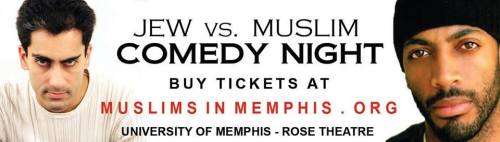
If you want to see more comedy from the Muslims check out Baba Ali’s website, check out some of islamwich’s lighter posts, and/or (very highly recommended) plan a trip to Memphis, TN for the Muslims In-Memphis’ Kosher and Halal comedy night on March 21.

mim comedy night

Stay tuned for next week’s post where I tell you all about my adventures, interviews, and talks in Memphis!

 Do you got jokes? Share them in the comments.

Follow us (upper right of the page), email us (islamwich@yahoo.com), like our face with your face on Facebook, like the post, share it, pin it, comment on it, and/or do whatever social media magic it is that you prefer. Find out more about us in the understandably named “About Us” page and browse other posts in our “Table of Contents”.


Feminism: Hijacked by White, Middle-Class Women

Feminism: Hijacked by White, Middle-Class Women

What follows is a speech given by Myriam Francois-Cerrah on the problems with feminism as it is viewed from the lense of white middle-class women. Being a white, middle-class woman, a feminist, and a Muslim it feels strange to reblog this. But as Francois-Cerrah says, “If it takes my white privilege to amplify this message, at least it will have served one positive purpose in the broader struggle for human equality”.

Image

Missing Muhammad

missing muhammadI have been walking around the past few days in a serious funk, wondering what was bringing me down. I had been attributing it to the news.

I woke up Wednesday to the news of 3 beautiful, intelligent, young Muslims murdered in their home by an Anti-theist who hypocritically claimed religion is the source of violence and hatred in the world.

On Thursday, I researched a case of a mosque burning in Ohio in 2012 where the criminal who set the blaze claimed he never met a Muslim and did not know what Islam was beyond what he heard on Fox News and talk radio.

Then I came upon a story where a women murdered a fellow human being by pushing him in front of an oncoming subway because, as she said, “I pushed a Muslim off the train tracks because I hate Hindus and Muslims ever since 2001 when they put down the twin towers I’ve been beating them up.” Her conflating of the two vastly different faiths shows her obvious ignorance.

does this look like religious freedom to you?

Just this morning, I  read news of an Islamic community and education center in Houston, TX that has burned down (it is not known yet if this was an accident or a hate crime). And I read about the murder of a 15 year old Muslim in Kansas at the hands of a man who harassed and taunted him for his faith.

I read several posts in my Facebook news feed over the past few days of Muslim women being insulted and harassed.

These crimes against humanity lay at the feet of Muslim Extremists, White supremacists, Christian Extremists, Fox News Talking heads, Talk radio bigots, Islamophobes, Anti-theists, and anyone who spreads hate and cheers in the face of lost lives and violence. It is my hope that these crimes will make them lose sleep and in the process lose their insane ideologies.

It is a distinctly sinking and sickening feeling to know that people hate you, want to see you suffer, want to kill you … people who don’t even know you. It is horrifying knowing that the media and well-organized and well-funded groups are implicit in twisting my religion and spreading lies to create this hatred of me and my people. It is most terrifying knowing that some weak-minded and uneducated Muslims play into this twisting of Islam and perpetuate these lies!

But still, this was not entirely the source of my melancholy.

Media lies and dehumanization of Muslims is nothing new. Islamophobes and their dark hearts have campaigned to distort my faith and defame me, my brothers, and sisters since the 7th century. Muslim ignorance and intolerance has been rife since Muslim majority lands have been torn apart, colonized, and continually destabilized by Western powers. And I have lived knowing these facts for more than 13 years.

However, the funk I was in took a different shape when I watched a lecture on YouTube by Nouman Ali Khan, a bright scholar of Quran and the Arabic language. While watching his lecture, I realized that nothing that will happen to the Muslims will be worse than the death of Prophet Muhammad (PBUH-peace be upon him).

I realized I was mourning the loss of the Prophet Muhammad (PBUH), a man I knew so well, but had never met. Yes, I had been depressed because of the lost lives and fear my community is facing. But also because in this time of crisis we will never again have Muhammad (PBUH) to lead us with the ultimate wisdom and mercy he came with.

It was the guidance from God that I missed. It was the man God sent with a smile and a sense of humor that I missed. I missed urgently and deeply a man I had never met.

And now, as I write this, I realize that we have his legacy. We still have God’s guidance sent through Muhammad (PBUH). And we can pick up were he left off. We can do our best to do as Muhammad did.

(from an article I wrote for OnIslam.net)

We can be honest like him

He was known as Al-Sadiq (the Truthful) and Al-Amin (the Faithful) among all that knew him—even his enemies.

When the Qaiser of Rome received a letter from Muhammad (peace be upon him) inviting the Qaiser to Islam, he asked Abu Sufyan about Muhammad. Abu Sufyan, who at the time was a staunch opponent of Muhammad’s message, said:

“Muhammad is nobly born; is honest and truthful, and has never broken a pledge. He enjoins his followers to worship none but One God and to pray to Him alone. He preaches kindness, piety and, tolerance towards all. And his followers are on the increase.”

This man was so honest that even his enemies called him the honest and the truthful. We can be like this too.

We can be protective like him


Muhammad (peace be upon him) lost his father before he was born and his mother at an early age, an experience that left a lasting impression on him. Having been vulnerable at an early age, he advocated for the good treatment of those who are vulnerable in society. He would attend to the needs of the indigent and the widowed. He took care of the orphans, and recommend others to do the same.

The Prophet said:

“The one who looks after and works for a widow and for a poor person is like a warrior fighting for Allah’s cause.” (Al-Bukhari, 6006)

“The best house among the Muslims is one where an orphan is well treated, and the worst house among the Muslims is one where an orphan is badly treated.” (Ibn Majah, 3679)

We can be good to the widowed, orphaned, the homeless, and the helpless in society. Nothing is stopping us but our selves.

We can seek justice like he did


Muhammad was an advocate for blind justice. He said:

“Assist your Muslim brother, whether he be an oppressor or oppressed.”

And when a companion of the Prophet asked:

“But how shall we do it when he is an oppressor?”

Prophet Muhammad replied:

“Assisting an oppressor by forbidding and withholding him from oppression.” (Al-Bukhari, 2444)

Here is a man who told people to be loyal to justice first even if it means witnessing against your own self. We too can reignite this revolutionary thinking-  and end bigotry, racism, sectarianism and so much more.

We can be honorable like him

Muhammad (PBUH) treated women with dignity and told his followers to do the same.

He never lifted a hand against a woman. He never lost his temper with a woman. He sought advice from women and advocated for women’s rights and their good treatment.

Prophet Muhammad (peace be upon him) told his followers:

Only an honorable man treats women with honor and integrity. Only a mean, deceitful, and dishonest man humiliates and insults them.”

Muhammad (PBUH) left an example to men and women alike. He emphasized the need to respect each other as full and actualized human beings.

We can be patient like him


Muhammad (PBUH) told us “The strong person is not the good wrestler. Rather, the strong person is the one who controls himself when he is angry”. This is an inspiration. We can claim self-control for ourselves as the only true strength.

Through learning about the legacy of his behavior, teachings, compassion, strength, and mercy; I learned how amazing a human being could be.

I learned what it means to love and respect someone I would never meet in this life. And I missed Muhammad. I still miss him, but I seek comfort in knowing that I and my brothers and sisters can and do strive to live his legacy.

Quran 25:63 And the servants of the Most Merciful are those who walk upon the earth easily, and when the ignorant address them [harshly], they say [words of] peace.”

Follow us (upper right of the page), email us (islamwich@yahoo.com), like our face with your face on Facebook, like the post, share it, pin it, comment on it, and/or do whatever social media magic it is that you prefer. Find out more about us in the understandably named “About Us” page and browse other posts in our “Table of Contents”.

More Fears Western Muslims Face

More Fears Western Muslims Face

fears of w. Muslims header Written by Theresa Corbin

Last time we spoke about what Western Muslims fear, we all had a good laugh. Then many people added to the list. And I had to agree. The list of complexes and paranoias Western Muslims suffer from can go on and on for days. So I have wrangled up some more fears of the Western Muslim. Let the games begin!

7. The Opposite Sex Handshake Prospect

The prospect of being in a situation where the hand of the opposite sex it shoved in your direction makes many a Muslims’ palms sweaty. In the West, the hand shake is a sign of professionalism or even mutual respect.

The keen Muslim knows this and doesn’t want to offend the person attached to the hand. But at the same time s/he does not want to unlawfully touch someone of the opposite sex- Islamically speaking, you don’t touch those not closely related to you. It’s a respect thing.

So, many Western Muslims constantly sweat over what to do. How does one handle the fall out of refusing a hand shake? You don’t want to be know as the rude prude. On the other hand (pun intended), how does one handle (another pun intended- I could do this all day!) the fall out of feeling like s/he has sinned. You don’t want to be a bad example or a sell out. MuslimGirl.net offers some solid advice here.

awkward handshake

6. The Dog Saliva Vigilance

Some Muslims are afraid of dogs for no good reason- insert cultural hang up here. And then there are those Muslims who love dogs and think of them as their children- insert endless Facebook pics of pet here.

Somewhere in between these groups are Muslims who like dogs but know that their saliva is considered unclean (think about what the dog licks and you can understand why).

So when the Muslim who understands the nasty situation in dogs’ mouths meets a friendly, lick-happy dog, he comes to a crossroads. In order to pet and play with the cute pup, he/she will have to spend the whole time clocking the dog’s tongue’s location. The vigilance is tiresome. Why can’t dogs learn to keep their tongues to themselves?

googly eyed dog

5. Eavesdropping into Infamy Paranoia

This paranoia descends on a Muslim who is convinced the CIA or FBI is eavesdropping on her/his cell. So she/he fears the moment when she/he is on the phone talking to her/his mom, spouse, friend; forgets about the tap; and starts whining, singing, burping or what have you.

The fear is that the FBI (or whatever gov. agency is into wire taps these days) will take the opportunity to record the humiliating behaviour, auto-tune her/his voice to some preposterous song, and put it on YouTube. And there he/she will live in infamy.

this phone is tapped

4. Condemnation Reflex-Complex

This situation develops when the Muslim’s reflex to condemn anything and everything bad that happens becomes so strong that it resembles a type of Tourette’s. When s/he should just get the iCondemn app.

Condemn it

3. Alcohol-anoia

Here we have a relatively popular paranoia among Western Muslims. It resembles swine-o-phobia in that the Muslim is vigilant and at times paranoid about having any alcohol (for swine-o-phobia, it involves pork ingredient) in their food, drink, or oral hygiene products because … well … it does happen to be in all vanilla extract, some ice creams, non-stick cooking sprays, most mouth washes and toothpastes. I could go on.

This results in lingering in aisle at the grocery store, pouring over ingredients lists, studying different names of alcohol ingredients, and can even lead to badgering waiters about all the ingredients in the menu at any given restaurant.

running-from-alcohol

2. Beach awkwardness

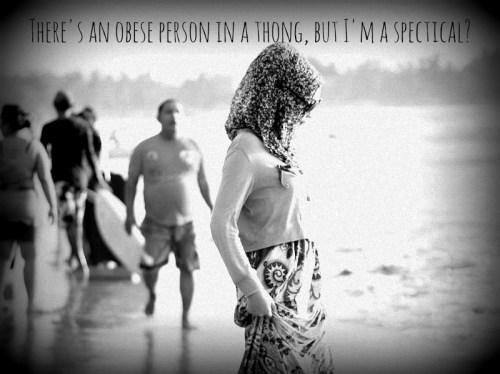
This is an intense feeling of awkwardness that involves beaches, but can be extended to any body of water. It occurs when the average hijab wearing Muslim lady wants to go to the beach on any given gorgeous day. But she knows that she will be the center of curiosity for her modesty even though she is certainly not the most absurdly dressed person on the beach.

at the beach

1. Fox News

Do I really need to explain this one?

Faux news

Follow us (upper right of the page), email us (islamwich@yahoo.com), like our face with your face on Facebook, like the post, share it, pin it, comment on it, and/or do whatever social media magic it is that you prefer. Find out more about us in the understandably named “About Us” page and browse other posts in our “Table of Contents”.

Take Back Islam: No More Double Standards Part 2

Take Back Islam: No More Double Standards Part 2

The Double Standard Dilemma: Part II

Written by Stephanie Siam

Last week we met Ali and Jennifer, a newly-married Muslim couple hailing from opposite sides of the globe.

Ali and Jennifer were caught in an issue that often arises in new marriages of the Islamic persuasion: the double-standard. Specifically, that men are often held to (or hold themselves to) different customs, traditions, rules and expectations than women are – within their families, within their societies and within marriages.

As previously discussed, the first way the ridiculous double-standard appear in an Islamic marriage is through the unequal expression of anger. For more about this, please check out Part I here.

The second way double-standards pop up in marriage is through the concept of working – both inside and outside the home.

Working Inside the Home

It’s no secret the United States experienced its own Women’s Suffrage movement during the late 1800s to early 1900s. That was merely to obtain the right for women to vote in federal elections. However, total equality for women is still a far cry from being checked off on the To-Do List of American Civil Rights.

Funeral Director pic
lordin’ it over the Wife

Despite women holding some of the highest positions of power in the States, and other “Western” countries – okay, that ONE position still hasn’t been attained yet … 2016, insha’Allah! – there are still certain stereotypes assigned to women and men, respectively, based on tradition and culture.

Move over a couple of continents, to where men are predominantly raised as princes, catered to for every menial task, and a new wife has a whole load of extra responsibility piled onto her that she might not have been asking for.

Add to this reinforcement by in-laws, society and misguided “scholars”, and the poor girl thinks she has no other choice in the matter but to be her husband’s servant for all of married life.

Take for instance Jennifer. When she moved in with Ali after they got married, she expected he would do his part in taking care of the home. After all, her father had always done his part around the house, especially when her mother worked long hours. When she and Ali had discussed marriage roles, she had mentioned that she was used to her father being active around the house. Ali had not disagreed at the time.

At first, Ali did make sure to keep his dirty clothes in the laundry room. He would also bring his dishes to the kitchen after eating, and he would take out the garbage if Jennifer asked him to.

One evening while they had guests over for dinner, Jennifer called Ali in from the living room to help her make coffee.

“Why did you call me like that in front of our guests?” Ali asked, coming into the kitchen in an angry rush.

“I want you to help me carry the coffee and dessert.” Jennifer held out the coffee pot and some plates.

“I can’t do that.” Ali turned and left the kitchen.

Confused and upset, Jennifer called him back into the kitchen, but he didn’t respond. In order to save face, she took the coffee and dessert out into the living room, served the guests and participated in the conversation until the other couple decided to leave.

As soon as the door closed behind them, Ali spun around in anger. “Don’t ever ask me to serve guests in my home!”

“What is wrong with you?” Jennifer asked. “They’re both of our guests. I’m not a servant.”

“No, you’re my wife. It’s not a man’s job to serve other people. It’s not my June Cleaverresponsibility to bring coffee and dessert.”

“Oh, really?” Jennifer put her hands on her hips and cocked her head to one side. “So, I suppose it’s my job?”

“Absolutely!” Ali stormed down the hallway, coming back a few moments later. “Where are my black pants?”

“Which black pants?” Jennifer was busy washing dishes, and she wasn’t in the mood to argue any further.

“The ones I wear to the gym. I put them in the laundry basket two days ago.”

“Are they not there?”

“I didn’t look. Didn’t you wash them?”

Jennifer let the dish drop into the sink and turned around. “No, Ali. I have been busy. I have a job, too, you know. I only do laundry on the weekend. If you needed them washed, you should have washed them. I didn’t put a password on the washing machine.”

“Wash my own clothes? What do I look like . . . a woman?”

With her mouth hanging open, Jennifer stared as Ali returned back down the hallway to their bedroom and slammed the door.

And so enters the familiar concept of housework being women’s work and men being free to make their messes and leave behind their piles of dirtiness and stinkiness without a second thought of who should be cleaning up after whom. You know, ‘cause it is beneath a man to clean a toilet. Buddy, you didn’t have any problems making it dirty. What makes me the default go-to for your sanitation process?

But this culturally-based idea of men’s immunity to housework is so ingrained in the minds of both women and men from many countries that it often goes unquestioned until it presents a problem in a mixed-culture marriage like Jennifer and Ali’s.

Of course, if we ask Ali, he’ll say that it’s the way it’s always been, or women are supposed to work inside the home Doing it ALLand men are to work outside the home. He may even cite some reference about how the Qur’an says women should “stay in their homes”.

However, what he will most likely avoid referring to is the issue itself: why must women be the ones to pick up after grown men that possess the ability to do it for themselves?

Why are men allowed to sit like kings in their homes, being served by women in every capacity from massaging their feet, bringing them food and drink to practically cleaning and dressing them?

Well, the answer is simple. They’re not.

When asked about how Prophet Muhammad (pbuh) acted in his home, A’isha (ra) said:

He was a human being like any other; he would clean his garment, milk his sheep and serve himself.

Additionally, Sadaf Farooqi tells us the Prophet (pbuh) did the housework and did not “lounge around” expecting the womenfolk to wait on him “like a king on his throne” – even though he did work outside most of the time (and the hadith about the Prophet doing housework is often misquoted as he “helped” with housework. This implies it was the wife’s duty, and he helped anyway. This is not the case. The hadith does not mention helping, but simply doing things for himself. . .because. . .well, he wasn’t broken or incompetent.)

After discussing the double standard of completing housework, it is only natural to move into the final and complementary issue of working outside the home.

Working Outside the Home

It is uncommon nowadays to find a marriage where both partners aren’t working. Even in the youngest countries in terms of “modernism”, newlyweds in their mid-20s to early-30s expect that both the wife and husband will need to work outside the home.

House Lifting
it’s a balancing act

Yet, the expectation remains that the wife, when her “job” is said and done for the day, will come home and keep working until she goes to bed at night: doing the dishes, bathing the kids, cleaning the house, cooking the food.

What ends up happening is the wife becomes overly stressed while the husband sits back and enjoys his time of relaxation after the work day is finished.

Some people say this is the woman’s problem, as she shouldn’t be leaving the house to work, anyway. But there’s nothing in Islam that forbids women from working outside the home.

As we know, Khadijah (ra) was a successful businesswoman even before the Prophet (pbuh) married her. In fact, El-Sayed Amin explains, it was through her business that she met her future husband.

Furthermore, it was Hind bint Utbah and Asma bint Abi Bakr who were instrumental in the success of the Muslims at the Battle of Yarmouk. Clearly, if women were permitted to fight alongside men on the battlefield, then their leaving the house to work at supermarkets in order to help support their families or schools to cultivate knowledge is not an issue.

But what is an issue is the insinuation that women should work outside the home and be responsible for all the work inside the home when they return. Not only is this not fair, but it is totally un-Islamic, as we see above in the discussion of the Prophet (pbuh) and his actions inside and around his home.

Just NO!
And just like in Twilight, this dude is not a real man.

Even worse, many men do not work outside the home. Instead, they rely on their wives to support them . . . and still expect them to take care of the children and the home upon their return from work!

The husbands will sit on the couch watching TV or sleep most of the day, and they don’t lift a finger to help their exhausted and over-stressed wives. Why? Because it’s not their job.

Now, I shouldn’t have to provide a reference showing how ignorant and selfish this belief is. Furthermore, what it ends up leading to is resentment on the part of the wife, and ultimately, dissolution of the marriage and family.

Conclusion

In short, there is only one way to fix the issue of the Double Standard Dilemma in Islamic marriages: communication. It’s one thing to clean up after your husband and serve him if it’s something you want to do. It’s another thing totally to force it on your wife because you believe it’s her job.

As Shahina Siddiqui reminds us:

And among His signs is this, that He created for you mates from among yourselves, that you may dwell in peace and tranquility with them, and He has put love and mercy between your (hearts): Verily in that are signs for those who reflect (Quran 30:21).


Follow us (upper right of the page), email us (islamwich@yahoo.com), like our face with your face on Facebook, like the post, share it, pin it, comment on it, and/or do whatever social media magic it is that you prefer. Find out more about us in the understandably named “About Us” page and browse other posts in our “Table of Contents”.