Image

The Islamic, Adult Coloring Book (Improved Edition!)

The Islamic, Adult Coloring Book: a tool for dawah, de-stress, & deen

The Islamic, Adult Coloring Book is 130 pages of awesome

available now on Djarabi KitabsAmazonAmazon UK, & Createspace.

About the Book:

In late 2015, my helper monkey whispered an idea in my ear. From this idea-seed, the first edition of The Islamic, Adult Coloring Book grew. And I–Theresa A. Corbin, queen islamwich bee–self-published The Islamic, Adult Coloring Book in early 2016 in an attempt to help non-Muslims understand a bit about Islam and to combat the rising tide of stress in the modern Muslim’s life. 

By late summer of 2016, I was approached by Papatia Feauxzar, Founder & President of Djarabi Kitabs Publishing. She wanted to know if I would be interested in publishing a second edition of The Islamic, Adult Coloring Book with Djarabi Kitabs.

I jumped at the chance to be a part of her amazing publishing house. Papatia made quick work of finding the very talented Naafi Nur Rohma to rework the images and make them even sharper and, honestly, better than I could have ever imaged.

Things went really quickly from there and we have published the new and improved version a little over a year after the first edition was published.

Why coloring?

Much research has been done on the concept of the adult coloring book as a form of art therapy. The results of these studies show that coloring for adults can benefit individuals suffering anything from cancer to stress.

Adding a spiritual/Islamic component makes this kind of art therapy beneficial in both this world and the hereafter.

The pages of The Islamic, Adult Coloring Book include detailed mosque architecture, calligraphy, tessellation, hadith (prophetic traditions), dua (supplication), Quranic verses, and quotes for Muslims to reflect on, to take time out of their rushed and hectic lives to recenter, refocus, and let their minds recharge, de-stress, and cultivate sabr (patience).

even cats love it!

In addition, each coloring page has a corresponding descriptive page for the non-Muslim colorer who wants to learn a bit about Islam free from myth or judgment all while relaxing. 

Is it just for adults?

It is called The Islamic, Adult Coloring Book because the designs are intricate works that the adult colorer will find both challenging and soothing.

But kids will certainly enjoy the book as well. Often older kids enjoy coloring books as much as the next guy, but obvs don’t want to use coloring books meant for young children. They are just not complex enough for them. So The Islamic, Adult Coloring Book is more suited to them as well. 

The Islamic, Adult Coloring Book is available on Djarabi Kitabs, Amazon, Amazon UK, & Createspace. It makes a great gift for anyone and everyone!

Keep your eyes peeled for the blog tour and giveaways July 15th-19th!

 July 15- The Muslimah Mommy – Interview and Giveaway!

July 16- Online Book Launch

July 17- Ilma Education – Interview and Giveaway!

July 18- Dpressed Muslimah – Giveaway!

July 19- Sarah’s Homeschool and YouTube Channel– Giveaway!

July 18- Goodreads – Giveaway!

Image

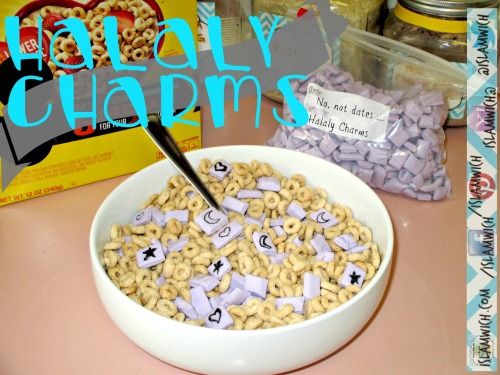
Halal Lucky Charms and the Cereal Experiment

Written and Test Kitchen-ed by Theresa Corbin

Yes! I did. I discovered a Lucky Charms marshmallow recipe. But it didn’t work, like AT ALL. Then I found another. And that was an even worse disaster (for all of those who are confused, Lucky Charms marshmallows have pork gelatin in them. Don’t know what halal is? It’s all good. Just click here.)

Halaly Charms


But after a few very messy attempts and a lot of stubbornness that I will call patience, I reverse engineered my very own recipe of the illusive Lucky Charms marshmallow– and I call it HALALY CHARMS!! And it is glorious!

What follows is a gangsta recipe that is not for the faint of heart. It is for the OG (Original Gangsta Grandma).

But first let me ramble on, as most food bloggers do, about my love affair with the food item in question. Let me tell you a little tale. Name has been changed to protect the guilty.

Once upon a time, there was a little girl name Eresa-Tay who loved sweets and cereal. When she stumbles upon a cereal that also had candy it in, it blow her mind.

Read more

Image

Domestic Violence: Excavating Shariah Series- Part 2

written by Theresa Corbin

Part 1

As a faith community, we are facing a serious crisis in human (and God given) rights violations. Many of those “in charge” are and have been misusing religious texts to cripple more than half of our population- women.

We are a global community and these issues have infected our lives on a global scale. Because of these issues, Saadia Haq and I are “Excavating Shariah” in an attempt to chip away at the fiqh interpretations (human understanding of the Shariah (Islamic) law) that have either intentionally or unintentionally ignored the female experience, oppressed women, or co-opted women’s religious dedication.

We take it as a serious matter that Islam has been wrongfully used as a weapon against women. We feel we have the right and an obligation, as Muslims, to speak on these issues. Currently we are “excavating” the affront that is Domestic Violence.

Domestic violence is a global issue. According to WHO “Most of this violence is intimate partner violence. Worldwide, almost one third (30%) of women who have been in a relationship report that they have experienced some form of physical and/or sexual violence by their intimate partner in their lifetime. Globally, as many as 38% of murders of women are committed by a male intimate partner.”

It is a men’s issue. But there are some (or rather many) who claim that Islam gives men the right to physically harm their wives.

In Islam, marriage is based on on love and mercy, as we read in the Quran:

{And among His signs is this: That He created mates for you from yourselves that you may find rest, peace of mind in them, and He ordained between you love and mercy. Lo, herein indeed are signs for people who reflect.} (Quran 30:21)

Read more

New Muslims: Why Celebrate Eid?

New Muslims: Why Celebrate Eid?

written by Theresa Corbin for About Islam

No matter what the weather, no matter how tasty the Eid breakfast, no matter how well I felt my Ramadan went, for many years after I converted to Islam, I followed the same old Eid pattern.

Wake up. Pray fajr (morning prayer). Eat breakfast. Go to Eid Prayer.

Then I, my husband or both of us, would go to school or work. It was anti-climactic at best.

After a month of character building, spiritual highs and building a better relationship with the Quran, it was always right back to pre-Ramadan business as usual, hoping to keep the lessons and increased faith as we exited the month un-commemorated.

Until one year, I said enough! I put my foot down and didn’t go into work. I took the day off of school and insisted my husband do the same. Guess what happened?

No, the world didn’t fall apart. No, we didn’t fail our classes. We actually enjoyed ourselves.

We spent time to acknowledge what Ramadan meant to us and to celebrate our successes in it. And because of our celebration we felt more Muslim somehow. We felt closer to our community. We felt better prepared to move on and face the challenges of life outside of Ramadan.

In the Western world where few even know what Eid is, it is very difficult to get out of day to day commitments to celebrate the holiday or rather the holy day. It is even more difficult to have that holiday feeling when those around you are treating the day like any other ordinary day.

As converts, we have to give up a lot of our old holidays when we come into Islam. Giving up holidays where everyone is celebrating and everything is decorated can be difficult.

Many of us treasure our holiday memories and family traditions. But as Muslim we are not left with nothing in the place of our old tradition. As converts we can and must make new traditions and create a holiday feeling for ourselves.

Why Celebrate? For Gratification and Gratitude

Read more

Gallery

Eid In A Can

Written and test kitchen-ed by Theresa Corbin

What is better that cheese in a can? 

That’s right, Eid in a can!

eid in a can

Eid means “Celebration”. There are two Islamic celebrations: Eid al-Fitr- celebrated after the month of fasting (Ramadan), and Eid al-Adha- celebrated after the pilgrimage (Hajj).

Cake (frosting + sprinkles)/love = Eid in a Can. It’s a simple equation, really.

Eid (al-Fitr) is right around the corner. And despite the fact that I don’t like posting stuff about food during Ramadan, I wanted to share my favorite DIY gift tutorial. Cake in a can!!

Read more

Image

Ramadan Explained

written by Theresa Corbin

It is that time of year again. Ramadan!

When the moon begins its new phase and the snow fa … err … the trees are in bloo … errr … the crisp smell of autu … errrr … Wait a minute. None of the seasonal sights or smells can be applied to Ramadan. What’s up with that?

ramadan

Well, if you don’t already know, it is because the Islamic calendar does not follow the same fixed calendar that we are used to in The West, where all the seasons occur in the same ‘ole months. Kinda boring, Greg of the Gregorians didn’t know how to keep it fresh, but whatever.

Every year the month of Ramadan starts when the new moon is sighted for the ninth month in the Islamic calendar. Each month is 29-30 days long depending on the lunar cycle followed by Muslims. This means that each year the month of Ramadan moves up 10 days in relation to the Gregorian calendar. Time to break out the calculator and do some math.

Just joking, I don’t do math.

This tracking of the moon and measuring the calendar by it is how some non-Muslims spread the lie that Muslims worship a moon god. FALSE in a major way.

Muslims worship the creator of all things known as God or Allah in Arabic. In fact, if a “Muslim” were to worship the moon, this would take him out of Islam, i.e. he would no longer be a Muslim because the first article of faith is to worship God alone. You know, the first commandment.

Anyway, I can get side tracked from time to time. Eh hem, Ramadan. The ninth month in the Lunar Islamic calendar. I am sure you have come across someone, somewhere that is excited or at least talking about the coming of Ramadan. So you do a quick search on the Google, and find out that it is the month in which the Quran was first revealed, and it is a month of fasting for all healthy, adult Muslims.
Read more

Image

A Greener Ramadan: A Brighter Future

written by Theresa Corbin for Al Jumuah

Many People Associate the color green with Islam. The flags of Pakistan, Iran, Saudi Arabia all include the color green. According to the Quran, the people of paradise will wear garments of green silk. And some say the Prophet’s (PBUH) favorite color was green. I have yet to find a reliable hadith to support this favorite color claim. But I think it is safe to think of Islam as a green hued faith for another reason: The Environment.

Embedded in the tenets of Islam is an ecological imperative. “The Earth is a mosque, and everything in it is sacred. I learned this basic tenet of Islam from my father,” notes Ibrahim Abdul-Matîn, environmentalist and author, who begins his book Green Deen: What Islam Teaches About Protecting the Planet with these wise words.

We as human beings were placed on this earth as caretakers of it, as stewards.

Now, behold! Your Lord said to the angels: I am placing upon the earth a human successor to steward it. [Sûrat Al-Baqarah, 2:30]

As stewards on this earth, we have been entrusted with its care, and we will be held accountable for our actions towards it.

We will register “in the book” what they have done and what footprints they have left, and everything we have accounted for in great details in a detailed book. [Sûrah Yâ-Sîn, 36:12] (emphasis added)

Ramadan is a time for self-examination, a time to come nearer to Allah, and to become better versions of ourselves. So as we contemplate how we can become better to ourselves and to each other, let us also contemplate how we can become better stewards to our home. Let us take this opportunity to be more cognizant of the footprint we leave, and have a greener Ramadan.
Read more