Image

Women Leading The Prayer

written by Theresa Corbin

The topic I want to tackle today is about women leading the Islamic prayer. The title gave it away, didn’t it? This topic, as all things confusing and provocative, is brought to us by the letter “F” and Facebook.

My talented and super busy social media manager shared a post on islamwich’s fb page about a woman leading the prayer at a masjid (mosque) in Copenhagen. The title was “The Future of Islam is Women”. Perhaps it is.

And as you can imagine, there were many who decided that they have the authority to declare who is going to hell. So much fun! Now my social media manager is experiencing a downward spiral in her faith and needs counseling because of all the harshness that was spewed over this post. 
Should women run masajid (mosques)?

My thinking on this “scandle” is that yes, women must be running masajid. There must be at least one woman on every masjid board. Period. Why? Because this is the example of the Prophet (PBUH). Prophet Muhammad sought advice from women often. Women in his community had a voice, a vote (see Sahih Bukhari 2732 for one of many examples).

Women must be on every board of every masjid and hold offices higher than that because we are half of the community. We are more than half of society. We are moral agents just like men. And if we want our community and society to function properly, women must be included as women were included in the Prophet’s shura (consultation). We must sit at the table, as the Quran says:

{Those who hearken to their Lord, and establish regular Prayer; who (conduct) their affairs by mutual Consultation; who spend out of what We bestow on them for Sustenance} (emphasis added- Quran 42:38)

Should women lead prayer?

Read more

Image

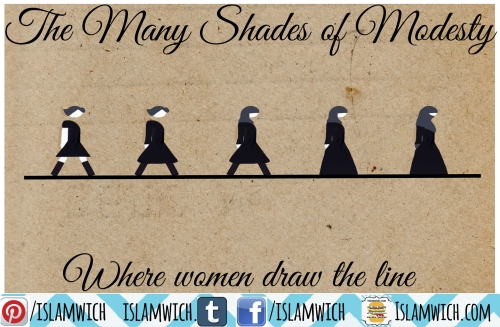
The Many Shades of Modesty

Written by Gracie Lawrence

I see you’re wearing pants today. Good for you. I chose to jazz things up with a shirt and a headscarf to boot. Too much you say?

Modesty means many things

Let’s be honest here, a whopping majority of us (Muslim, Christian, Jewish, Agnostic, or otherwise) do believe in some form of modesty–of course there are those outliers who believe in nothing at all–but I think most of us would agree that those conditions are not always very sanitary.

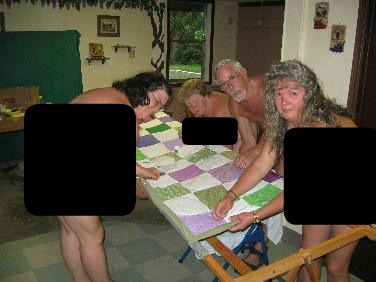
You don't quilt in the nude? YOU'RE THE PRUDE!
You don’t quilt in the nude?
YOU’RE THE PRUDE!

We women are especially notorious for scrutinizing one another and making harsh judgments, while men generally get a pass from our scrutiny.

Is that dress too low cut for her age? Does she have the body to pull off that outfit?  How can she wear that at a funeral/wedding? … 

Usually, to men, the more naked a woman-the better. Few from this gender do protest from seeing too much. And to those that are on the opposite side of the isle exclaiming that our covering isn’t enough–it isn’t like you will ever stop looking at us regardless of what we wear–lower your gaze, brother. There is no need to call the Haram Police.

While the judgments made between women can be harsh, it is in these critical comments where we decide where we want to draw our own personal modesty line–which helps us decide what amount of coverage makes us feel comfortable ourselves and in the company we keep.

Read more

Image

What Makes Being a Muslim Woman Hard in the West?

Written by Gracie Lawrence

There are tons of scholarly articles that explain the Islamic stance of women- so I am not going to go into that in depth. However, as the internet is also filled with information intent on making Islam look crazy, thanks to some very dedicated groups, here are some more reliable sources for those who are interested in the woman’s role in Islam.

being-muslim-woman-in-the-west-is-hard


But in a nutshell, for those who do not know or have the time to research into the above links, here’s a clue:

And for women are rights over men similar to those of men over women. (Quran 2:228)

Yes, there is a lot in Islam that is about rights between family members (husband/wife/kids), neighbors, business partners, and even between me and you, dear reader. But those “rules” are not what makes being a Muslim woman hard, it is what restores the balance to a system that can be overrun with those who sometime take too much or sacrifice more than they should.

But having a relationship can be difficult, especially when one party is thought of as just a stereotype. And the predominate stereotype that I see about me and other fellow converts- is that we are backwards.

And how do I know that there are many with this belief? Because campaigns like this have to be launched: Not ‘Brainwashed’

For those who absolutely insist that I am backwards because I chose Islam for my life – I doubt I will do much to change your mind if your identity and confidence is built on the misconception that 1. I am oppressed. 2. I am an idiot 3. This poor oppressed idiot of a woman needs saving.

Read more

Image

Who Does the Housework?: Marriage Issues

Written by Theresa Corbin

Traditionally, in most parts of the world, men left the home and worked for a few hours a day and earned money, while women worked 24 hours a day cooking, cleaning, and child-rearing for free. 

There are examples in many societies were these roles where not so clear cut. We can think of a quite a few examples of Muslim women who were (are) business owners, boss ladies, scholars, etc. And we can think of many examples of Muslim women who took (take) care of the home and family, and even examples of women who did both.  

who does the housework

But in modern times, it has become a matter of degradation to be the one in the family who does the dishes, washes the clothes, and generally takes care of the home and family. Some even go as far as to call it “woman’s work”, and view nurturing and caring for our property and our loved ones as humiliating tasks.

There is nothing wrong with being a homemaker, whether you are male or female. In fact it takes a strong person to work for free and without much gratitude from others.

Read more

Image

Female Genital Mutilation- Excavating Sharia Part 2

As a faith community, we are facing a serious crisis in human (and God given) rights violations. Many of those “in charge” are and have been misusing religious texts to cripple more than half of our population- women.

We are a global community and these issues have infected our lives on a global scale. Because of these issues, Saadia Haq and I are “Excavating Shariah” in an attempt to chip away at the fiqh interpretations (human understanding of the Shariah (Islamic) law) that have either intentionally or unintentionally ignored the female experience, oppressed women, or co-opted women’s religious dedication.

Female Genital Mutilation Part 2

Part 2 Written by Theresa Corbin

We take it as a serious matter that Islam has been wrongfully used as a weapon against women. We feel we have the right and an obligation, as Muslims, to speak on these issues. Currently we are “excavating” the affront that is Female Genital Mutilation (FGM).

What is FGM

“Female genital mutilation (FGM) comprises all procedures involving partial or total removal of the female external genitalia or other injury to the female genital organs for non-medical reasons” -The World Health Organization (WHO)

There are four types of FMG that increase in horrific nature from the removal of the clitoris to the removal of all external genital tissue and creation of a seal over the vagina, leaving only a small hole for urine and menstrual blood to escape.

It’s hard to read, I know. But imagine having to live through it. A few years ago, I read about the procedures in depth and I was beyond shocked by the brutality and severe physical and emotional scars and complication the victims are left with. Read more here if you want to know more about this brutal reality.

History of FGM

Read more

Image

Female Genital Mutilation- Excavating Sharia Part 1

As a faith community, we are facing a serious crisis in human (and God given) rights violations. Many of those “in charge” are and have been misusing religious texts to cripple more than half of our population- women.

We are a global community and these issues have infected our lives on a global scale. Because of these issues, Saadia Haq and I are “Excavating Shariah” in an attempt to chip away at the fiqh interpretations (human understanding of the Shariah (Islamic) law) that have either intentionally or unintentionally ignored the female experience, oppressed women, or co-opted women’s religious dedication.

FGM Excavating Sharia


Part 1 written by Saadia Haq

A new low was achieved this August, thanks to an Egyptian politician Elhamy Agina blatant argument that women’s sexual appetite needed to be curbed through FGM because in reality “men were sexually weak” and unable to match their bedroom demands.

This caused an international outcry whereas I was transported back into time during my university days in Jordan. My short time in Amman provided me with insider view into the Middle Eastern cultures; soon I made lots of female friends that were pleasantly welcoming to a South Asian Muslim woman. The unique combination of studying rights issues in a progressive Muslim nation like Jordan and living together with diverse group of women from Arabian and African nations helped foster many bonds that have grown stronger with time.

Continue reading on Saadia Haq’s blog The Human Lens here

Follow us (upper right of the page). Email us (islamwich@yahoo.com). Like our face with your face on Facebook (facebook.com/islamwich). Tumble with us on Tumblr (islamwich.tumblr.com). Pin with us (pinterest.com/islamwich). Follow us on twitter (@islamwich).

Like the post, share it, pin it, comment on it, and/or do whatever social media magic it is that you prefer. Find out more about us in the understandably named “About” page and browse other posts in “Table of Contents”.

Image

Aisha’s Marriage in Focus

Written by Theresa Corbin

I’ve written about it in the context of other issues a couple of times now, but I thought Aisha’s (Allah be pleased with her) age at marriage deserved a post all on its own. Because lots of people have this same question: Why did the Prophet (PBUH) marry Aisha when she was so young?

Aisha's Marriage in Focus

We don’t know Aisha’s age when she married the Prophet Muhammad (PBUH). The thing is they didn’t keep birth records back in those days. They also didn’t celebrate birthdays or really even keep track of age. We do have reports that Aisha was anywhere from 9-18 at the time of her marriage.

What is important for us to understand about Aisha’s marriage to the Prophet is that we cannot apply our standards in 2016 to people 1,400 plus years ago and vice versa. When people do put lives 1,400 years ago into 21st century context, it is as if they admit to not understanding historical context or ever having taken a history class in their lives. And that’s just sad.

Life in the 7th c.

We do not live in the same world at all. In the 7th century people were not guaranteed to see the ripe old age of 30. People matured early and were ready for marriage a heck of a lot earlier. Looking back even a few hundred years ago, the legal age of marriage was as young as anything from 10-14 years old. 

Richard A. Posner, chief judge of the U.S. court of appeals writes, “The law governing the age of consent has changed dramatically in the United States during this century. Most states codified a statutory age of consent during the nineteenth century, and the usual age was ten years.” [1]

Marriage in the 7th c.

The practice of marrying early was not an aberration to the people during the time of Prophet Muhammad (PBUH) and Aisha (May Allah be pleased with her). Christians, Jews, and pagans all married very young. So if we are going to criticize Prophet Muhammad’s marriage to Aisha, why don’t we have a problem with King John of England marrying 12-year-old Isabella of Angoulême? 

Read more