

Written by Stephanie Siam
When I started wearing hijab about 10 years ago (more or less), I did it out of sense of duty to Allah.
I believed – and still do – that Allah commands us to dress modestly and appear a certain way in public or in front of non-mahram (non-familial) males. Since I was new to Islam, I wasn’t completely aware of the injunctions he also placed on men to dress and behave in their own form of modesty. I’ve since learned that – shockingly! – men, too, must dress appropriately when in public or around non-mahram women. We can save the societal double-standards discussion for another day.
As any new hijabi knows, it takes a while to get the hang of wrapping yourself in a scarf every day. I’m not talking about the temperature. I’m not even referring to the mental fortitude one must develop to go out in public dressed extremely different than the cultural norms of society (depending on where you’re from).
I’m talking about the literal act of wrapping the hijab. Not getting it to fall off. Or choke you. Or look like you took a giant curtain and twisted it around your head. Or just gave up and piled a bunch of material on top. Or – my personal favorite – like you stuffed your head in a pillowcase and cinched it so tight your cheeks turn purple.
As time passed, I became more accustomed to the art of scarf-wrapping. In fact, I can now do it without looking in the mirror – an amazing feat, if you ask me.
Still, there comes a time when, despite my attempts at keeping everything covered the way it should, the scarf shifts and a bit of (ah!) sin skin peeks out. On these rare occasions, I usually have my reliable husband around to say, ever-so-bluntly, “Your meat is showing.”
My meat.
And, once again, I realize even though I’ve taken care to display the most modest appearance possible (for me), I’m still taking the chance someone might get a glimpse and ogle me. All at once, I am relegated to the display case in a butcher shop. Something men can stare at, drool over (yeah, okay) and decide whether to take home or skip over.
While I do my best to remind the hubs that it’s called “skin” and not “meat”, and that I’m not a piece of it, when I see others making ridiculous comparisons between women who wear hijab and those who don’t, I do my best to change the discourse. Or at least draw attention to the oversimplification and objectification that such comparisons promote.
Case in Point:
While doing my work scanning Facebook the other day, I came across the following cartoon that had been posted on a Christian/Muslim debate page by Sara Hassan Walid.

Beneath her post was the question: “Make sense now?”
I read the cartoon several times before I finally responded: “No, it doesn’t make sense. Who covers apples, anyway?”
At the time, I was just making a statement. I didn’t realize why the cartoon so badly rubbed me the wrong way. Was it the colors? The word choice? The over-patriarchal man dressed in what looks like his sleeping gown and slippers? Finally, it occurred to me.
In all sincerity, the whole cartoon makes it seem like men have devised this way of concealing something of importance (I would’ve chosen something more precious….like a diamond, as per usual). However, wearing hijab is not something men came up with to protect and conceal things. Hijab is a commandment of Allah, and He decreed it as protection from unwanted advances and for modesty purposes.
The cartoon nearly comes to the point of having men claim ownership of the idea of hijab. Astigfur Allah!
Next, and probably most glaringly, the tactic of comparing modesty to an apple is ridiculous. First, there is no direct connection. Second, it simplifies the beauty and ultimate purpose of the hijab. Third, an apple can be washed off if it gets physically dirty, as can a person. However, hijab does not prevent a person from getting spiritually dirty (sinning) any more than a cloth keeps an apple from rotting on the inside. The whole analogy is just…….
In other such cartoons, the comparison has been between women and pearls or diamonds (or other precious items). At least this is slightly more connected. The purpose in covering a diamond is to protect it from….jealousy, coveting, theft (a more synonymous analogy, albeit still personally offensive).
But the purpose in covering fruit is to keep it clean, right? To stop it from spoiling?
My problem with the analogy is not that it encourages hijab. It’s the insinuations:
1) Men “cover their women”. Men don’t do this. Sure, some men do out of jealousy or control issues — but the commandment to cover comes from Allah, not man. This cartoon plays into the stereotype that Muslim men “make their wives cover”. This is wrong.
2) “Covering an apple” (or diamond, as previously stated) would be to keep it clean. Now, it’s just plain naive to think wearing hijab keeps a woman “clean” (sinless, pure, modest, chaste … whatever you want to associate “clean” with). And it’s offensive to say that just because a woman doesn’t wear hijab means she’ll be “dirty”. This analogy feeds into the stereotype that men “pick” women based on cleanliness (purity, virginity, sinlessness (?!?!), demureness). Well, shouldn’t this go both ways? Where is the cartoon about a Christian woman (as this cartoon is labeled Christian vs. Muslim debate) asking a Muslim woman why they “make their men wear long beards” or “make their men wear thobes (Islamic dresses for men) to the ankles”?
The problem with the whole cartoon is that it feeds into stereotypes … stereotypes, in fact, that cause people to dislike Islam (men controlling women, oppression of women, women are less than men) in general. When these types of cartoons are shared, it propagates the idea that life (especially in the Muslim world) is all about “men choosing (and for) women”. This relegates women, once more, to the position of property and removes their humanity (which happens as it does in any part of the world, but is not an Islamic concept.)
Why can’t the cartoon say:
Man 1: Why do Muslim women cover?
Man 2: Do you ever feel like you’re being judged by the kind of clothes you wear?
Man 1: Sure, doesn’t everybody?
Man 2: Do you ever feel like you have to dress a certain way to impress someone?
Man 1: Sure, doesn’t everybody?
Man 2: Do you ever find yourself dismissing someone simply because of what they look like or because of how they’re dressed?
Man 1: I hate to admit it, but yes.
Man 2: Do you ever have a hard time concentrating because someone is wearing something strange or revealing?
Man 1: Of course.
Man 2: Well, Allah gave Muslims protection against all of this. Hijab is not just an article of clothing. It’s a style of modesty. It’s not just for women, either. Men, too, are expected to dress modestly and behave that way. Muslim women cover because they prefer, instead of being judged for their clothes or trying to impress others with their labels, to be evaluated based on their actions, performance and contributions. But not all Muslim women cover. Just like not all non-Muslim women wear revealing clothing. There are all kinds, brother.
Man 1: That’s given me a lot to think about. Thank you for explaining it to me. The next time I see a covered women, I’ll remember that.
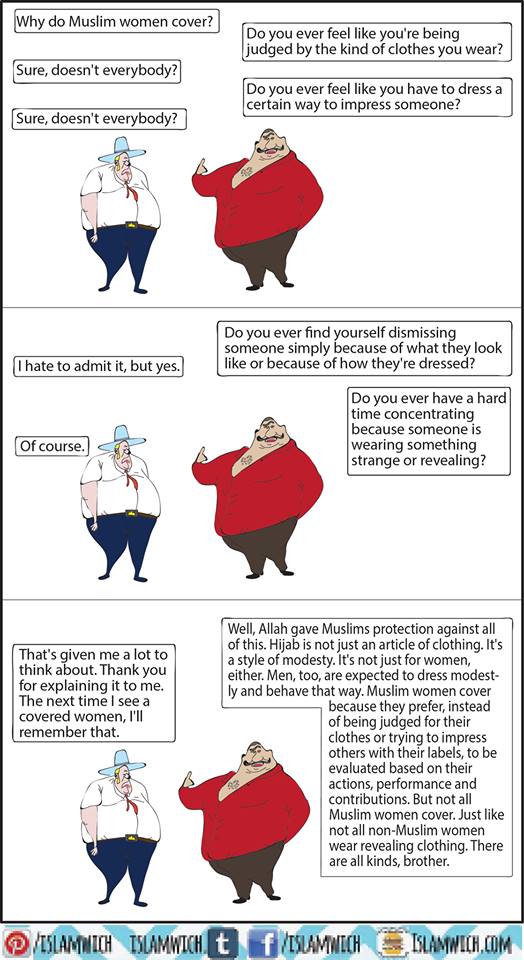
Isn’t that a better conversation? It asks specific questions, clarifies purpose and intent, and also spreads positive knowledge about Islam and modesty.
Maybe I’m taking this way out of proportion. However, the cartoon rubbed me the wrong way (as you can obviously tell), and I try very hard to spread positive images and positive knowledge about Islam to non-Muslims and fellow believers alike. Not because I think I know more, but because I think there is more to the discussion than the trite explanation given in a two-line exchange. (exhale)
Bottom line, hijab is more than just a cover. And women are more than just objects that need to be “kept clean”.
Oh … and just for a final blow … I can’t stand the image of the non-Muslim man.
It looks like someone photoshopped a banana out of his hand. Like he was walking by, eating a banana, and asked this question — which prompted the answer using the analogy of fruit.
And, in any matter, if the writer HAD to use fruit … a banana would’ve been better.
Follow us (upper right of the page). Email us (islamwich@yahoo.com). Like our face with your face on Facebook (facebook.com/islamwich). Tumble with us on Tumblr (islamwich.tumblr.com). Pin with us (pinterest.com/islamwich). Follow us on twitter (@islamwich).
Like the post, share it, pin it, comment on it, and/or do whatever social media magic it is that you prefer. Find out more about us in the understandably named “About” page and browse other posts in “Table of Contents”.

 islamwich